Having missed the photoexhibition at the Moscow Photo-biennale of the photographs of Sokurov's 'Russian Art', I made sure that the Mishukov exhibition on Zviagintsev's 'Elena' was something that wouldn't be missed. The Mishukov photos are something more than a mere record of the shooting of the film 'Elena' and have an artistic power to them in their own right. Mishukov managed to take his photographs at those moments of rest and preparation but some of the photographs of the leading characters capture some simply splendid moments and they give themselves to new readings that may or may not have been in the film. One of the really fascinating exhibitions of the Moscow Photobiennale.
Sergey Shestakov: Journey into the Future :Stop #2 Gudym
Chris Marker's The Great Premakes film poster series.
This year's Photobiennale in Moscow has as one of its themes 'Film' and there have been some splendid exhibitions so far of photos from Sokurov's 'Russian Ark' as well as of Kozintsev's 'Hamlet' which I reported on earlier http://giuvivrussianfilm.blogspot.com/2012/04/exhibition-of-stills-from-kozintsevs.html Another exhibit is Sarah Moon's haunting photo-animated film called 'Le chaperon noir'. Coming up are further exhibitions of Ingmar Bergman & Wim Wenders. Apart from this there have been some splendid exhibitions devoted outside of the film theme. For me the best two American exhibitions are those of selections from Los Angeles Criminal Archives - a real surrealist joy to see as well as some of William Klein's photos of New York in 1955. Jane Stravs 'American Express' was also of high quality. Martin Carr's photos of New Brighton in the UK chronicling the early years of Thatcherism through images of petty consumerist excess and litter were also well worth a viewing. Harry Gruyaert's photos of late perestroika Moscow and his later photographs chronicling Moscow's aggressive capitalism are a fascinating portrait of the transformations of a city after two decades. Finally, Sergey Shestakov's post-apocalyptic Journey into the Future#2 gives us another zone-like landscape after his first part chronicling Chernobyl. Here Shestakov gives us a portrait of an abandoned army town in Chukotka where in the Khrushchev period an underground base had been built. These landscapes have a Stalker-like feel to them. Returning to film the New Manezh Gallery has an exhibition devoted to the filming of Zvigintsev's 'Elena' and another real filmic treat is at the Moscow Museum of Contemporary Art which is showing some of Chris Marker's photographs of North Korea as well as of his clandestine wrist-watch photos taken in the Paris metro along with some of his invented film posters imagining previous incarnations of films such as Hiroshima Mon Amour and Owl People etc.
One of the most interesting exhibitions being held at the moment is the one devoted to the 75th anniversary of the 'museification' of Mayakovsky. Although not in the same premises for 75 years it was in that fatal year of 1937 that a Mayakovsky museum and library were to be opened. While the Mayakovsky Museum itself is not hosting any special exhibition, the Proun Gallery at the Vinzavod Complex (a Gallery noted for its attention to exhibiting the Soviet avant-garde) is showing the graphic art works held by the Mayakovsky Museum (but rarely publicly exhibited). The graphic works of El Lisitsky, Rodchenko, Sen'kin and Klutsis are being put on display here until the 8th May. Quite a treat for anyone interested in the photomontages of these great artists.
Alek Epstein's book 'Total 'Voina'(War): Art Activism in the Era of Tandemocracy' gives one a particularly fresh insight into the movement which led up to the recent Pussy Riot scandal. Nadezhda Tolokonnikova - one of the three alleged Pussy Riot members- played a significant part in the 'Voina' art group. Epstein- an Israeli journalist and scholar who has previously specialised in the Israel-Palestine question- has given an insiders account of this group and the development of its many actions. Perhaps most famous was the painting of the huge phallus outside the FSB headquarters in St Petersburg but there were many others which achieved greater or lesser public resonance. Epstein explains the development of the group, the schisms, the ideology and the origins in earlier art activist and artistic trends as well as the movement from art to political activism which has been especially true of the Moscow wing of the group in recent times. Epstein is well acquainted with the members of the 'Voina' group and herein lies his especial attention to the inner workings of the group. He also pays a lot of attention to the role of Aleksei Plutser Sarno who, in many ways, controlled the way that the group was received as well as, according to Epstein, influencing the process of exclusion of certain early members of the group. The book is, perhaps, the first full-scale attempt to describe this art activism in contemporary Russia and the group 'Voina' and it is to be hoped that a translation could be in the offing. While it doesn't give too much detail on the genesis and context of the group in terms of contemporary Russian art movements it does mention names like Alexander Brener, Monastirsky and others such as Edward Limonov who are in some way predecessors. The availability of material on the group in English is detailed in Plutser-Sarno's blog on Voina http://plucer.livejournal.com/537393.html and while awaiting a more detailed, scholarly and dispassionate account of Voina, this book by Alek Epstein is a reasonable beginning filling in many details of the history of one of Russia's most radical art group.
At the Solyanka Gallery in Moscow a Tarkovsky exhibition has just opened. Apart from showing almost fourty films about or by Tarkovsky and those most closely associated with him it also has a number of exhibits ranging from photographs, to sketches for films and storyboards as well as a selection of film posters, costumes from various films and juvenilia ranging from letters that Tarkovsky wrote as a child to his parents to some of his own early art works. It is in many ways a minor exhibition for those who don't have the time to sit in to watch the films but nonetheless the Solyanka is one of the few places in Moscow to mark the 80th anniversary of Tarkovsky's birth and they should be commended for this small but worthwhile exhibition.
The photos range from sketches for Andrey Rublev, Solaris, his VGIK film 'The Killers', a costume for Ivan's Childhood, posters for 'The Steamroller and the Violin' and 'Stalker' and an oil painting by Tarkovsky from 1956.
Last month at the Multi-media Museum in Moscow a small exhibition of stills from Kozintsev's 'Hamlet' took place. Here are some of the stills on display (apologies for the poor quality of the reproductions).
If most of the attention on Russian film this year is focused on Zviagintsev's 'Elena' and Sokurov's 'Faust' this year another film deserves a certain recognition. A recognition that it clearly hasn't seemed to get even in Russia. This week Nikolai Khomeriki's black and white film Сердца-бумеранг (Heart's Boomerang) has been released and yet it is showing at only one cinema in the whole of Moscow - the Pioner - on Kutuzovsky Prospekt. A great shame as there is a lot to be said in defence of this film even though few commentaries- even among professional critics whether in the Russian film journal 'Seance' or in the recent article by Mihaela Mihailova for the site Kinokultura http://www.kinokultura.com/2012/35r-bumerang.shtml have really shown any real enthusiasm. And yet Khomeriki is starting to look like one of the few really original voices to have emerged from the New Wave that has emerged in fits and starts since 2003 and the Zviagintsev/Koktebel revelations of that year.
As Elena Gracheva argued in her article Bместо катарсиса ('Instead of Catharsis') in the Seance magazine, Nikolai Khomeriki has managed to use a perfect plot for melodrama and turned it fully against itself. That the predicament of learning that one can be victim to sudden death can be cathartic is done away with in this film. The knowledge for the protagonist is not a turning point and only seems to deepen his catatonic acceptance of a life lived with reticence and apathy. It is this truth which shatters preconceptions that have been held far too long and which makes the film so radical. (In this way it resonates with Zviagintsev's 'Elena' and the protagonists similar lack of a noticeable reaction to her own act of murder). There are other parallels with Zviagintsev (this time with the film 'Banishment') in the deliberate refusal to locate the action and furthermore in stirring up the confusion by filming in two contradictory locations - in 'Heart's Boomerang' the St Petersburg underground is filmed with Moscow external scenes.
What Khomeriki brings to Russian film is a new sensitivity that is not necessarily purely Russian. His work with Leos Carrax and Philippe Garrel and his studying at French as well as Russian film schools (in Russia he studied under Khotinenko but was also taught by Alexei German and Vladimir Menshov) has meant that there are certain aspects of Khomeriki's work which are rather unique to Russian film. He himself has spoken about how few Russian directors have given their full attention to filming female characters (and his previous film сказка про темноту 'A tale about darkness' was notable in the attention paid to bringing about a new angle to the cinematic image of woman in Russian film). He has reached a point in 'Heart's Boomerang' where these two cinematic cultures have managed to merge successfully and where their negative aspects are excised. The Russian film critic Roman Volobuyev succintly spoke of how their is a contrast between the European phonetics and syntax of the film (Garelist mis-en-scenes and elipses) and a deeply Russian semantics- with all of Khomeriki films exploring the world of тоска́.
The film recalls a number of films of the Thaw - whether it be Ioseliani's Жил певчий дрозд (There lived a song-thrush) or the early films of Muratova but Plakhov also mentions Agnes Varda's 'Cleo from five to seven' as being as the source of inspiration for the film. The unrelenting but rhytmical beauty of the sequences in which the protagonists travels trance-like into the tunnels of the metro also recollect something of Ermanno Olmi's rhythmical exploration of lifeless routine in his films 'Il posto' and 'Lunga vita alla signora' as well as the laconic protagonist of Свободное плавание (Free Floating).
This is a film which will surely gain a greater reputation in time and people will surely soon wonder at the lack of an adequate inital response to this truly world-class film by a truly original voice in Russian and European cinema.
.
The emphasis on confinement and isolation is achieved thanks also to the superb cinematography of Shandor Berkeshi who has managed to perfectly capture the visual reality of "a world where freedom is no longer an option" (Mihailova in Kino Kultura). Berkeshi also shot 'Roads to Koktebel'' that first venture into the new Russian cinematic wave that Khomeriki belongs to.
One of the most unusual films I remembered watching at Moscow's Muzei Kino- before it was shut down by gutless bureaucrats and Nikita Mikhalkov- was the yiddish-language film Возвращение Нейтана Беккера 'The return of Nathan Becker', made in 1932 at the behest of Belarus Film studios. One of the only yiddish language films made in the Soviet Union this was to be only part of a long history of Jewish cinema in the Soviet Union whose story has been recounted by Miron Chernenko in his volume entitled Red Star- Yellow Star Красная звезда - желтая звезда (кинематографическая история еврейства в России). No clips of the film seem to be available on Youtube but I did find this extraordinary clip of Mikhoels playing King Lear at the Jewish State Theatre in 1935. Mikhoels was to be killed off in a staged motor accident in 1948 (given his phenomenal popularity in the Soviet Union and abroad a show trial would have been too risky for Stalin) whereas the script writer Peretz Markish (father to the Russian language Israeli author David Markish) was subjected to a show trial along with a number of Jewish intellectuals and exceuted along with them on what was to become as the Night of the Murdered Poets. In English the extraordinary tale of Yiddish cinema in the Soviet Union is told in J. Hoberman's short essay 'A face to the shtetl: Soviet Yiddish Cinema, 1924-1936' (published in 'Inside the Film Factory'). A film on Jewish Theatre in the Soviet Union called 'Balancing Acts' has been made (a short clip of which is available on youtube http://www.youtube.com /watch?v=KF1ZOvMi18k ). This article from Haaretz also talks about David Markish's relation to his father and to Isaac Babel http://www.haaretz.com/culture/arts-leisure/tongue-tied-on-the-page-1.284239
The Soviet 1920s didn't signal only the flowering of Yiddish language art but was also the location of a brief renaissance in Roma culture- a story which has been barely told. I was made aware of this fact one day on a car journey from Bratislava to Brno by one of the Czech Republics foremost scholars of Roma culture, the late Milena Hübschmannová, who told me of the extraordinary Soviet writer of Czech roma origin, Alexandr Germano and the flourishing renaissance of roma culture in the Soviet Union of the pre-Stalin period. The Romen theatre, founded in 1931, is still running today and in fact the first major musical-dramatic performance was Жизнь на колёсах (Life on Wheels)- based on a play by Germano. A brief history of this theatre is given in its wikipedia entrance http://en.wikipedia.org/wiki/Romen_Theatre
From the Russian Film Blog I discovered this little gem of an animated film by Dziga Vertov (here is the link to this post http://russianfilm.blogspot.com/2012/03/soviet-toys-1924-dziga-vertov-goskino.html). By the way for any Russian/Soviet киноманы (film buffs) I'd strongly recommend the blog as it is much more regular in posting than I am and offers a whole host of subtitled clips of recent and sometimes historical films. Knowing of Vertov's contempt for fiction I was quite astounded at this ten minute clip. It seems though that Vertov was at the very heart of the process of initiating Soviet animated film. Another two films Случай в Токио (An Incident in Tokio) and Юморески (Humoresque) are recorded as being directed by Vertov. The rather basic techniques used in the 'Kultkino' studies in 1924-1925 were soon superseded. For some notes in Russian on this early period here is a link with further information: http://www.myltik.ru/index.php?topic=interes/history&fe=history3
In a previous post http://giuvivrussianfilm.blogspot.com/2010/02/telemaco-signorini-ilya-repin.html
I noted the similarities between a painting by Telemaco Signorini and
one of the great classics of Russian art: Ilya Repin’s ‘Barge Haulers on
the Volga’. A visit to the Tretiakovskaya Gallery a few months ago on Krymsky
Val suggested that the link between Telemaco Signorini and Russian art
was more than simply hypothetical. Although the great Russian artist is
better known for his works on historical and religious or biblical
motifs, the time spent in Italy clearly shows how Ghe was influenced by
the macchaioli movement and, in particular, by Telemaco Signorini. He
spent a number of summers in the Gulf of Poets near La Spezia which was
to influence not only Shelley and Byron but also D.H.Lawrence and Mario
Soldati. Many of Ghe’s landscapes of San Terenzo or Carrara bear the
unmistakeable stamp of the macchaiolo technqiue of Signorini or
Cabianco. One more link in the chain of mutual Italian-Russian
influences. And one more indicator that Liguria and Tuscany are the most
‘Russian’ of Italian regions. The great Mordovian sculptor Stepan Erzia who I blogged about yesterday would also spend time in
Italy precisely in this Ligurian-Tuscan borderland so rich in artistic
and literary history. Other names linking Russia to Liguria include
those of Marina Tsvetaeva, Tchaikovsky, and Vrubel. An early twentieth century writer from the
La Spezia region who has written some fascinating pages on the Cinque Terre and Lunigiana Ettore Cozzani also had many links to late 19th century Russian exiles living in Liguria.
A trip to Saransk in September 2001 was the first time I
would hear of Stepan Erzia, a sculptor from a Mordovian tribe who would spend
most of his life outside of Russia living for over two decades in Argentina and
also spending years in France and Italy. A further exhibition in Moscow later
in the same year meant that for the first time I could see a selection of his
sculptures. (In Saransk as far as I remember the museum was closed for
reconstruction). It is only now that I have decided to return to the city and
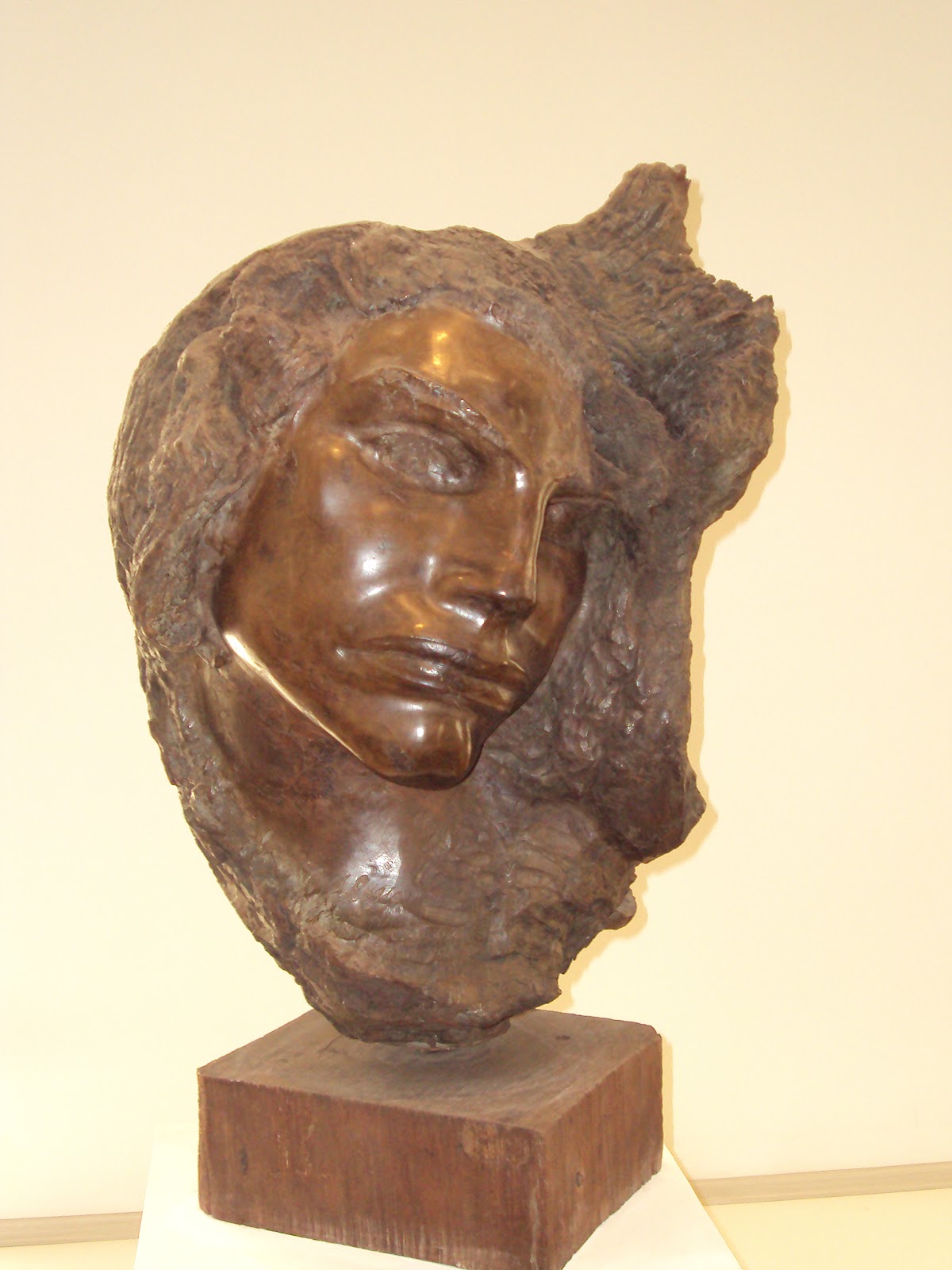
visit the museum which holds the largest collection of his works. A whole floor
of the museum is devoted to Erzia’s sculptures and the chance to see some like
his sculpture of Moses is undoubtedly a rewarding experience. While it is
stated that the Museum holds two hundred of his works, less than a hundred were
on display. Many of these were those produced in Argentina with new materials
such as the quebracho and algarrobo and yet it was well before this period that
Erzia made a name for himself.
Erzia would become Mordovia’s most rooted and yet most
cosmopolitan and universal of artists owing much to his extraordinarily errant life
story. His birth in a small Mordovian village – Bayevo- to a family of peasants
in pre-revolutionary Russia meant that his development as artist was no simple
one. In fact his professional education would only begin at the age of 26.
Nonetheless, his assimilation of this training was very rapid. His
revolutionary sympathies with the 1905 revolution would lead him to emigrate to
western Europe in 1907 due to the
repressive climate of the aftermath of the revolution. His trip to Italy and
then France would lead him to absorb all the influences of classical Italian
sculpture as well as more contemporary European sculpture. He would visit the
studio of Rodin in Paris and be influenced by the tragic images of this sculptor
as well as the bright expression of images (a greater influence than the exuberance
of Italian impressionists). A return to Italy in 1914 would lead to his
mastering of marble (given his presence in the marble capital of Massa
Carrara). Amidst his works created in Italy were the figure of St John the Baptist
created for the cathedral in la Spezia and a figure of a Priest. A friend of
his, an inspector of museums, Ugo Nebbia, would write a novel based on the life
of Erzia in Italy entitled ‘Il Viandante’ (The Wanderer).
Erzia would return to Russia in 1914 at the eve of World War
One and although he planned a rapid return to Western Europe (leaving his
sculptures in European studios) he was not to return for over a decade. His marble
sculptures in the latter period of the 1910s allude to the influence that
symbolism was to have in this period of his career (‘Repose’ in 1915 and his
monumental ‘Dream’ (1919) were the two most notable examples of this
influence). Post-revolutionary times would show him active both pedagogically
and in the erection of public and monumental sculpture in Yekaterinburg, Baku
and Batumi. Influenced by the work of Sergey Konenkov he would change from using
marble to wood- this search for a new style would become evident in his time in
the Caucasus and a certain modernist influence is perceivable in his work ‘Flying’
– the influence of Vrubel’s ‘Demon’ is detectable in this work.
His exhaustion of the revolutionary theme was
becoming palpable and an invitation to Paris on the behest of Lunacharsky would
evidently lead him on to a new odyssey which would mark his mature years. Due
to the difficulties of travelling within Europe Erzia would arrive in Argentina
via Montevideo and then spend two and a half decades working with quebracho and
algarrobo (two types of wood) to model some of the most impressive of his
sculptures. The hardness, the wide range of hues and the expressiveness of
quebracho would especially lend itself to Erzia’s sculptures and the expressive
contrast between the polished and the unpolished in these works are central to
his unique place in contemporary sculpture. The contrast in style between the
male (more expressive and indicative of a sense of abandon and hopelessness) and
female (more full of grace and perfection) portraits is an especially
significant indicant of his work. His models of different national types are
another important feature of this period. His return to a Mordovian theme reflected
in some ways a sense of homesickness.
His return to the Soviet Union in 1950
would be a return marked with both initial neglect and it was only after Stalin’s
death that an exhibition of his works would be staged in a showroom on
Kuznetsky Most in Moscow. This exhibition in 1954 would be one of the first artistic
signs of the post-Stalinist thaw. However his final years were a mixed time in
which he live in a country which he barely recognised. He died in 1959
(according to one legend he died after tripping onto the statue of his head of
Lenin hitting his own head against the head of the leader of the world’s
proletariat). He was buried in Saransk.




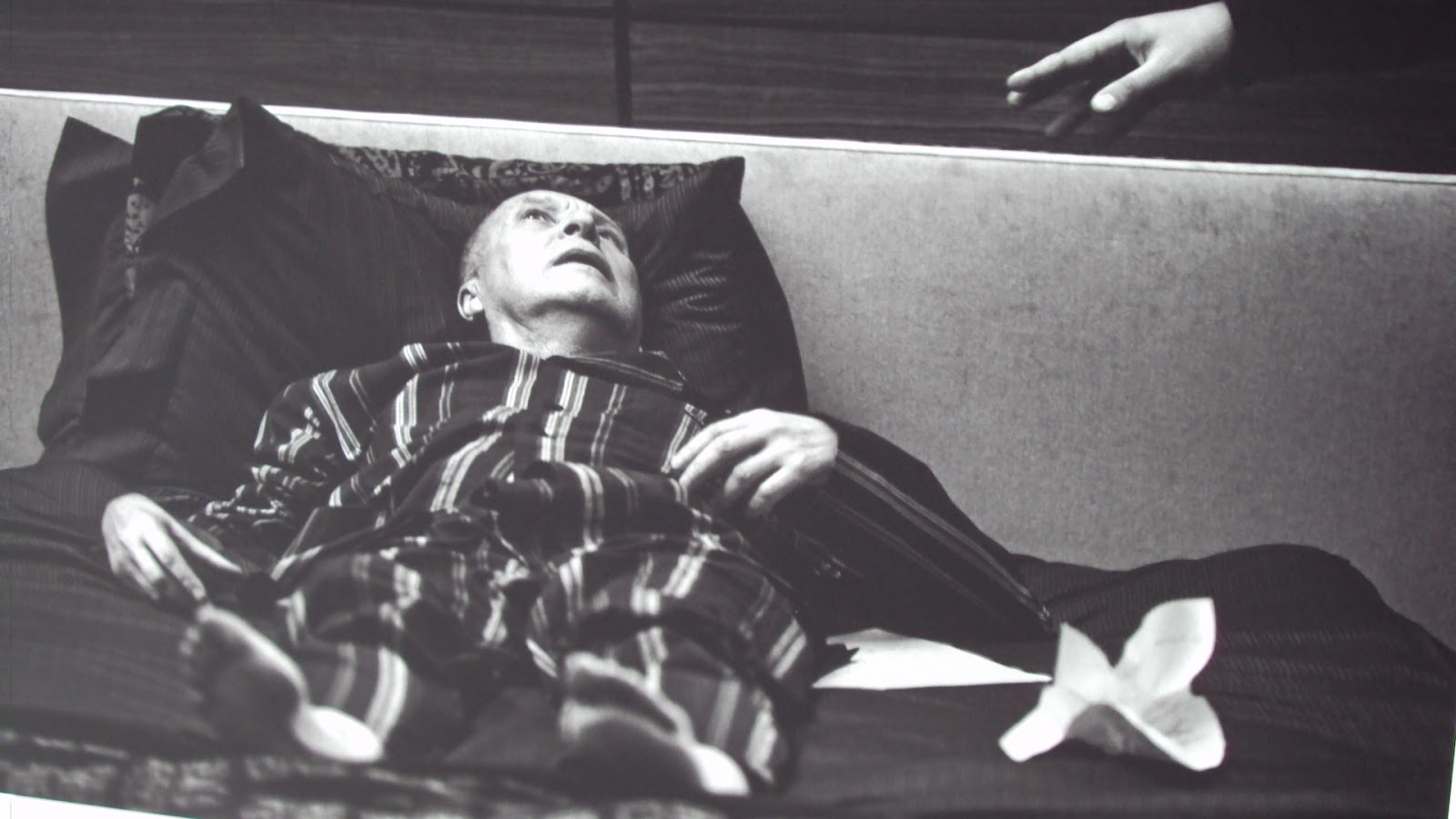


 Having missed the photoexhibition at the Moscow Photo-biennale of the photographs of Sokurov's 'Russian Art', I made sure that the Mishukov exhibition on Zviagintsev's 'Elena' was something that wouldn't be missed. The Mishukov photos are something more than a mere record of the shooting of the film 'Elena' and have an artistic power to them in their own right. Mishukov managed to take his photographs at those moments of rest and preparation but some of the photographs of the leading characters capture some simply splendid moments and they give themselves to new readings that may or may not have been in the film. One of the really fascinating exhibitions of the Moscow Photobiennale.

 Harry Gruyaert Moscow 1989-2009.
 William Klein New York 1955
 Los Angeles Criminal Archive Photo
 Sergey Shestakov: Journey into the Future :Stop #2 Gudym
 Chris Marker's The Great Premakes film poster series.


 One of the most interesting exhibitions being held at the moment is the one devoted to the 75th anniversary of the 'museification' of Mayakovsky. Although not in the same premises for 75 years it was in that fatal year of 1937 that a Mayakovsky museum and library were to be opened. While the Mayakovsky Museum itself is not hosting any special exhibition, the Proun Gallery at the Vinzavod Complex (a Gallery noted for its attention to exhibiting the Soviet avant-garde) is showing the graphic art works held by the Mayakovsky Museum (but rarely publicly exhibited). The graphic works of El Lisitsky, Rodchenko, Sen'kin and Klutsis are being put on display here until the 8th May. Quite a treat for anyone interested in the photomontages of these great artists.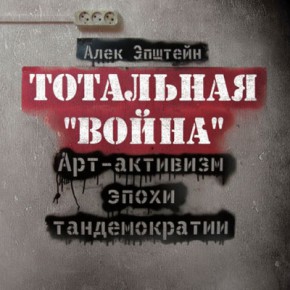


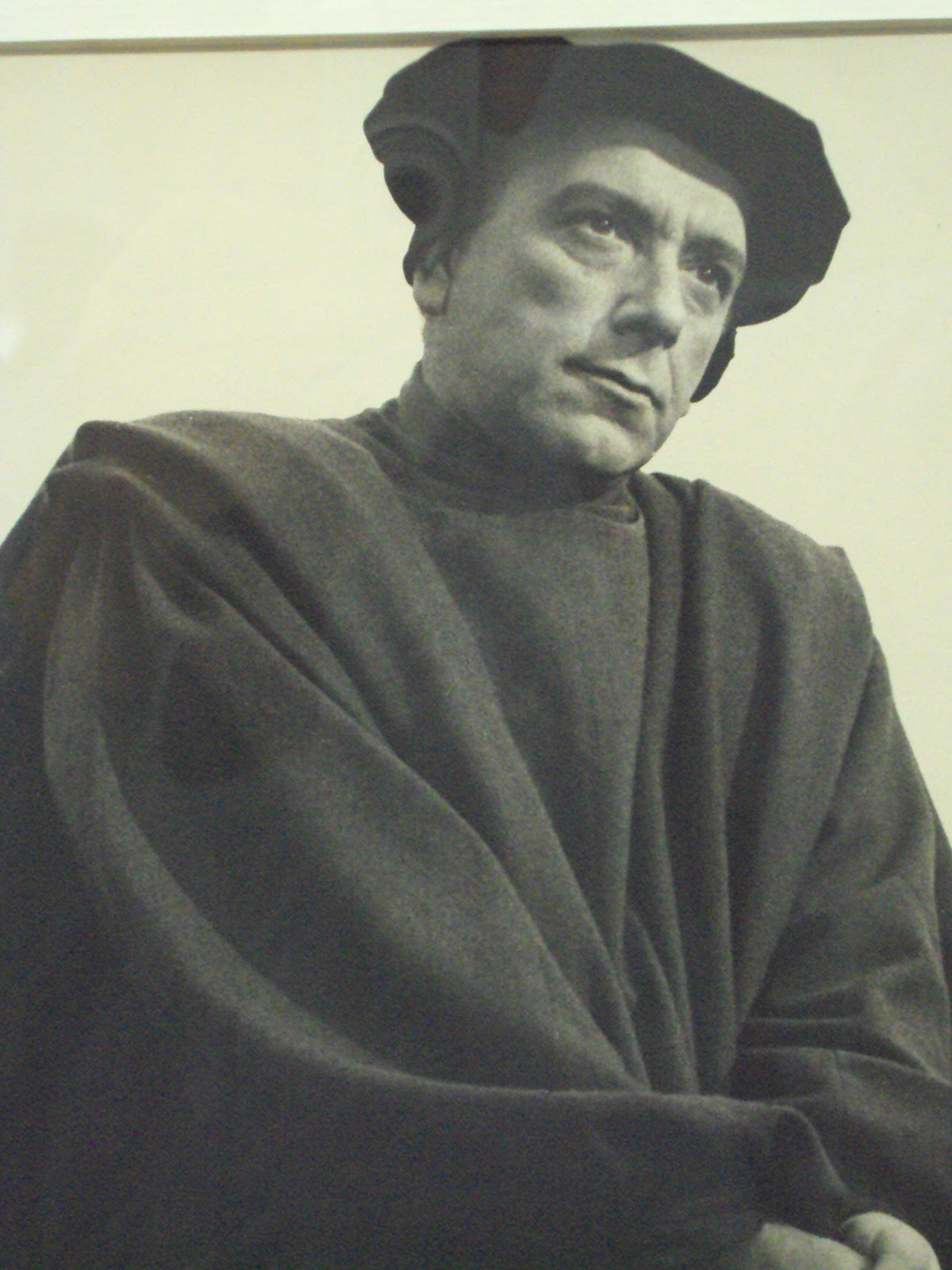


 Solomon Mikhoels



 Posts
Posts