Total Pageviews

Sunday, 30 May 2010

Some Film Venues in Moscow


Coming back from my ten week stay in Russia I am beginning to reflect on the ways that the historical memory of Soviet film culture is being kept alive in some form or other. This is a painful subject in many ways. The gutless sale of the Cinema Museum by the Filmmakers Union a few years ago was the single biggest blow to any project of keeping alive the historical memory of Russian and Soviet film culture. I wrote about this place in a former post of mine: http://giuvivrussianfilm.blogspot.com/2009/11/musei-kino.html and won't repeat my words here. For those who may be interested in the occasional activities that it carries on at a variety of venues may go to their website : http://www.museikino.ru/announce/ Most recently it has been showing an excellent retrospective of Czech films from various historical periods.

Much of the Cinema Museum's hundreds of thousands of exhibits have been stored at the Mosfilm Studios (pictured above). Their site in English is http://eng.mosfilm.ru/ Twice a week it is possible to turn up for an excursion round their site, although few of the Cinema Museum's store of exhibits are available on public view. A tour is given in which many of the motor cars, the sets and the props, makeups and decorations as well as the Old Moscow set that was specifically built for a film by the present Mosfilm director, Karen Shakhnazarov are on view. The excursion, however, gives only a rather superficial look at the 'attractions' of the Studio and is not a serious exploration of the history of the Studios. It would be nice if the Mosfilm Studios would take a more active role in explaining its own fascinating history.

With the disappearance of the Cinema Museum, they are only one or two cinemas that will show old soviet films. Perhaps the most established one is the Iluzion cinema which, however, caters mainly to older and more populist tastes and rarely shows films that have true aesthetic brilliance. In the past two months there was only the odd film that really made a trip to this cinema worthwhile (a showing of Khutsiev's 'July Rain' was the only film standing out in recent showings) with the exception of its films dedicated to the Chekhov film adaptation season that it ran in honour of the recent 150 anniversary celebrations of this classic author. Nonetheless, there is sometimes a rare treat and it is after all the only cinema left of its kind. One other cinema in the centre of Moscow, the Khudozhestveni cinema near the Arbat, does have a weekly showing of old Soviet documentaries normally followed by an audience discussion with the presenter. Also in some of its smaller halls it does occasionally show some Russian and Soviet as well as foreign classics. In one day I managed to watch Bauer's 'Twilight of a Woman's Soul' and Murnau's 'Tabou', though both, alas, were DVD projections and not from 35mm copies.

A more recent venue has sprung in the guise of the Eisenstein Library in Karetny Riad. If one forgives the fact that it, too, shows its films from DVD projections it has some excellent retrospectives. I missed the earlier Chekhov film festival and also the more recent films dedicated to filmmakers born in the year 1945 from Abdrashitov to Fassbiner but saw many of the films of its excellent retrospective of films related to the three German generations which I commented on earlier http://giuvivrussianfilm.blogspot.com/2010/04/three-generations-of-german.html The presence of actors such as Batalov and Filipenko, directors like the Germans, Abdrashitov and Bobrova as well as many cinema scholars introducing the films themselves make this an excellent venue for those who may want to learn more about Russian cinematic history. The site address is http://www.eisenstein.ru/

Another place which has tried to keep alive the historical memory of Russian film is, interestingly, the Meyerhold Museum. An excellent series of lectures and film showings have tried to show the impact that the great theatre director, Vsevolod Meyerhold had on Soviet film. Many film actors begun their careers under Meyerhold and even many directors had very strong links to this cultural giant. The debt that Eisenstein had to him was always acknowledged and impossible to underestimate but the story of Meyerhold and cinema is one that would fill volumes. The site of the Museum in English is available here http://www.meyerhold.org/

One other venue of some interest for cultural lectures is the recently opened Garazh Centre of Contemporary Culture. Lectures there are very regular and on many different subjects relating in some way to culture. Talks on architecture, Soviet fashion and the flappers of the 1920s as well as an excellent talk on the crisis by one of Russia's foremost independent Marxist thinker, Boris Kagarlitsky, were the three events that I managed to attend after having only belatedly found out about the lecture series in this new museum space.

These are a few of the venues which attempt to keep the flame of cultural historical memory alive in Moscow. Not enough given the huge hole that the loss of the Cinema Museum's Krasnopresnenskaya venue has caused. Yet along with the presence of Russia's television Kultura channel these are some of the few places where the looming twin shadows of commercialised pap and Mikhalkovian kitsch don't loom too large and where something, however minor, seems to be pulled from the wreckage that commercialisation and 'patriotisation' is causing.

As far as St Petersburg is concerned I have little knowledge. However, the recent attempt to set up a new festival under the guidance of Alexei German Senior seems to bode well.

Monday, 17 May 2010

Abram Room - A Strict Young Man (Strogy Yunosha)


Among the many films that merit rescuing from near oblivion, Abram Room's 'Strogy Yunosha' (A Strict Young Man) is surely one of the most fascinating examples of what was still being made (if not shown) in the 1930s. This is a film that was not shown publicly until the seventies at a cinema dedicated to the reshowing of earlier films (Kino povtornogo filma) in Moscow but was to astound the likes of Alain Resnais and Michelangelo Antonioni who were to discover in Room's film of 1935 something that they were trying to acheive more than three decades later.

This is a fantastic example of Soviet Neo-Classicism the like of which was not seen again. The aesthetic might lead one to make references to Leni Riefenstahl, yet this is only true to some extent. This film is not just one of Room's best (argaubly as interesting in its own way as his earlier 'Tretia Meshchanskaya' or 'Bed and Sofa' which has been justifiably championed in an excellent book by Julian Graffy) but it also shows an attempt to put into film the themes of Yuri Olesha's novel 'Zavist' (Envy) who was the scriptwriter. The music for the film is composed by Gavril Popov whose talent some have compared to that of Shostakovich and there are fantastic performances by Yuri Yuriev,Maxim Straukh, Room's wife Olga Zizhneva and a young and brunette Valentina Serova. There is a unique atmosphere in the film in which the wife of an older and successful doctor is sought after by a young and poor Komsomolets. The 'liubov v troem' theme is played out once again but in this case there is a barrier and the idea of envy and unequalness is explored. This film in which Room arguably explored real philosphical issues surrounding equality in the new Soviet system is a film set. nonetheless, in a strange dream-like reality with a hint of the fantastic. Equally present in the film are Olympian ideals and ancient Greek myths. The notion lurking is that the present had somehow brought to life this ideal. Perhaps, the most surprising shot in the film is the first one in which the naked heroine comes out of the water (this is, probably, the only erotically shot nude - although no close up and from the back - in Stalinist cinema).

The Olympian ideal, the philosophical text, the dream-like and out of time atmosphere, the Neo-Classical architecture and style of the film makes it something unique in Soviet cinema. Having the aspect of a dream within a dream, it has hints of an early 'Last Year in Marienbad'. Its disco-throwing scene of custard pies is one of two or three moments in which it has a definitely Bunuelesque feel. Yet, just as Olesha's 'Envy' was a book which had no follow-up in Soviet literature, so Room's film is a unique moment in Soviet film history. A path that was not taken but an extraordinary example of a unique masterpiece that would only decades later be fully appreciated by some of the world's most masterful film directors.

Monday, 10 May 2010

Great Films about a Great War


Given the slogan that Mikhalkov wanted to 'sell' his sequel to 'Burnt by the Sun' "a great film about a great war", I have been thinking about the really great films that have been made in Russia and the former Soviet Union. Soviet film really is full of such films and I think it would not be an exaggeration to say that a number of them would be included in the list of the greatest war films of all time. Klimov's 'Come and See' is, without doubt, one of the most powerful and haunting war films made in the history of cinema. It marked Klimov's final transition from satirist (in his early films) to a filmmaker who would describe the absolute horror of war. It was, alas, Klimov's last film to be made - the late Klimov was never to make his long planned 'Master and Margherita' which may have shown us an absolutely new Klimov. Klimov's wife, Larisa Shepitko, was also to mae great films about the war.Her 'Ascension' was, in part, a polemical response to Alexei German's 'Proverka na dorogakh' (A Check-up on the road'). The point of contention between the two great filmmakers was the question of choice, betrayal and atonement. For Shepitko betrayal was a final betrayal and she couldn't bring herself to accept a character like Lazarev who had betrayed and then atoned for his betrayal. Shepitko's portrayal of the female air pilot in 'Krylia' (Wings) is a memorable portrayal of the generation gap between those who fought in the Second World War and those who grew up in the Thaw period. A film of lesser artistic quality but with a scene that never fails to bring one to tears- Belorussky Vokzal (Belorussia Station)- by Andrei Smirnov also attempts to talk about the fading reality of the war and the problems of the war generation in the early stagnation period. Both Smirnov and Shepitko were to contribute short films to the trilogy of 'Nachalo Nevedemogo Veka' (the beginnings of an Unknown Era) in 1967 with short films based on the Civil War period.

The early Thaw period also can be said to be full of masterpieces exploring the Great Patriotic War. Tarkovsky's 'Ivan's Childhood' was, perhaps, one of the first films to fully explore the experience of a child in wartime and clearly it has themes that would be reworked by Klimov a quarter of a century later. Some still continue to believe Kalatozov's and Urusevsky's 'Letiat Zhuravli' ('The Cranes are Flying') as the best war film. It is as much Urusevsky's camerawork that works on us as the dramaturgy and the new attitude to betrayal which german would rework in his 'Proverka...'. The humanist theme is continued by Chukhrai's 'Ballad of a Soldier' which also gained a very positive reception when it was made. Another director whose work explores war - sometimes directly, sometimes obliquely -is Marlen Khutsiev. It was the scene of the visit of the ghost of a dead soldier to the main character (his father) in 'I am Twenty' that was to draw Khruschev's ire (for the young soldier replies to his son that he can not tell him how to live and Khruschev found this an outrageous supposition) but also the scene at the party (and the toast to potatoes that Sergei proposes and the discovery by his mother of lost ration vouchers) is significant in exploring the shadow that war still throws upon the Thaw generation. Khutsiev was to more directly explore the Great Patriotic War in his films 'The Two Fyodors' and in his much underrated 'In the Month of May' (this was a film made for television but it touched on questions that had been rarely touched upon in Soviet films about the war, including the discovery of the concentration camps).

Recently I have managed to rewatch Alov and Naumov's 'Peace to him who enters' (Mir Vkhodyashchemu) - a superb humanistic portrayal of a trip by Soviet soldiers with a pregnant German woman to a hospital at the end of the war. The theme of muteness (a thread in sixties Soviet cinema) is encapsulated by the dumb soldier who has been shell-shocked by the horrors of the war but who provides the moral leadership of the group. Other powerful explorations of the Soviet experience of war is the Gerogian director Rezo Chkheizde's 'Father of a Soldier'- a film about a father searching for his son during the war.

Films made during the war itself are many and although there were many technical deficiencies, this period was marked by a relaxation of tight censorship. Films like 'Nashestvie' (Invasion) by Abram Room were even to give an ex-prisoner (quite clearly a political prisoner) the status of a hero. Another significant film is Barnet's 'Odnazhdi Nochiu' (Once at Night) which depicts the films heroine in a unique way reminiscent of the Lilian Gish heroines in D.W. Griffiths films and quite unlike the Donskoy heroine of 'Rainbow'. One may see in Barnet's film a precursor of the Samoilova character in 'Letiat Zhuiravli'.

The late Stalinist period rewriting of the war with Stalin as a demi-god like figure directing all operations from his office in films by Savchenko and Ermler and almost religious-like saviour descending from the skies in Chiaureli's 'The Fall of Berlin' was, arguably, only saved by Barnet's excellent Hitchcockian spy-thriller 'Podvig Radvedchika' (Exploits of a Scout)- a genre that would then become immortalised in the Stagnation period in the television series 'Semnadtsat Mgnovenie Vesni' (Seventeen Moments of Spring) and the less well-known but excellent 'Myortvy Sezon' by Savva Kulish and starring Donatis Bannionis (of Solaris fame) and Rolan Bykov.

These are only a few of the masterpieces on World War Two. The list would go on for a very long time.

Khrzhanovsky's 'A Room and a Half' in the UK


There have been two short reviews in the Guardian by Peter Bradshaw and in the Observer by Philip French of 'A room and a half' in connection with the excellent news that the film is coming to UK screens. The Philip French review can be quoted in full (as it is a very small review):

This touching and amusing movie is a biography, both imaginative and imaginary, of Joseph Brodsky (1940-1996), the self-taught poet, critic and translator, raised in Leningrad, the son of a Soviet naval photographer, and persecuted by the state for his independence of mind. In 1972 he was driven into American exile where he achieved intellectual eminence, and he received the Nobel Prize for literature in 1987. Brodsky never returned to Russia and apparently once said that "such a journey could only take place anonymously". Khrzhanovsky takes Brodsky on a journey back to Leningrad, dreaming about his youth, upbringing and early life as he takes the ferry from Helsinki to Leningrad before being reunited with his elderly parents. The director uses animated sequences to elegant effect, and his affectionate, nostalgic movie brings to mind the autobiographical works of those other exiles, Vladimir Nabokov and Andrei Tarkovsky.

This hardly gives a full picture of the brilliance of this film. I added my commentary to the review which I reproduce here:


This is a truly wonderful film and it really deserves immense praise. The way that Andrey Khrzhanovsky handles the mixture of animated, narrative, quasi-documentary footage is superb. I watched the film over a year ago in Moscow and was immediatley captivated by it and have since watched it on DVD- it is the kind of film that can only improve after each viewing because there is so much in the film.
Yursky and Friendlikh (Brodsky's parents in the film) are two of Russia's most superb actors. Khrzhanovsky is undoubtedly one of the most splendid animated film directors not just in Russia but in world cinema and the animated sequences are absolutely splendid.

This is a portrait of Brodsky which doesn't set him up on a pedestal as some sort of martyred genius. Moreover there are no idle speculations on the Jewish theme. No, instead this is one of the best films about the sense of time and exile available. Khrzhanovsky uses an assortment of filmic devices but in such a way that one feels that nothing is forced.

This is one of the films that I wished that people would judge Russian cinema by because it puts on show exactly what Russian cinema is capable of (Khrzhanovsky shows that Russian cinema is truly capable of miracles even nowadays).

Alas, when I saw the film it was being put on at only one cinema in central Moscow and even after being awarded three Nikas (the major Russian film awards) this spring, it still is only being repeated in one cinema (the same one that showed the film last year). A real shame- Russia showers the mediocre likes of Mikhalkov, Khotinenko and Fedor Bondarchuk with millions to film trash and ignores the fact that real contemporary geniuses live in its midst.

A few points about the short reviews by Philip French and Peter Bradshaw: saying that Yursky has the look of a Pasternak is a rather comical overexaggeration - I read this to a Russian and they burst out laughing (Pasternak had such a striking and unique appearance that it is an exaggeration to compare just about anyone to him) and while, in this respect, the Tarkovsky and Nabokov comaprisons by French may not be quite so far out, I still don't think they are not necessarily the best references to make for this film. This film reflects a polystylism that is, arguably, closer in some ways to Paradjanov than to Tarkovsky (although again Paradjanov wouldn't be the major reference to make)- I think, if one were to search influences on the style of Khrzhanovsky the barely known film Cain XVIII may be said to have a large but indirect influence on Khrzhanovsky. It would be wonderful if the BFI could put on a retrospective of Khrzhanovsky's animated films- then we would know that Khrzhanovsky is not someone who can be compared to others but that he is a truly great master - maybe one day we'll be talking about him in the same breath as we talk about Fellini (by the way his animated film 'Long Voyage' based on Fellini's is superb).


Alas, newspaper reviewers are very rarely great conoisseurs of Russian film and the attempt to compare new Russian films constantly with Tarkovsky is something that gets carried to the point of absurdity. Nonetheless, thanks for small mercies (I suppose) that the film was actually reviewed at all.

Monday, 3 May 2010

A Look at Contemporary Russian Theatre by Anna Vislova


The fact that little of that much interest seems to be showing at the cinemas in the past week and not having any real desire to watch Mikhalkov's film a second time, I've been reading a little. One of the books that caught my eye was the book by theatre critic Anna Vislova on contemporary Russian theatre since the fall of the Soviet Union. An author of books on the legendary Soviet actor Andrey Mironov and on the Silver Age, she has recently published her take on more contemporary drama.

The position that she takes is that theatre in contemporary Russia has taken a wrong turning and instead of returning to a modernist path in which theatre could be a force looking at contemporary society, it has become trapped in a neoliberal worldview and has simply allowed itself to be trapped in a vicious circle of post-modernist irony and black humour. Her relationship to Soviet theatre is not uncritical and her book is not a nostalgic look at what was but a hard look at the wasted opportunities of the possibilities that theatre could have been used for in a free and more democratic space. Vislova notes some of the aspects of how theatre has failed its role in contemporary Russia by being the cynical voice of the moneyed elite. Her complaints include those of it relying too much on 'styob' and completely losing any tragic voice (relying instead on a cynical black comedy), of simply echoing western trends and not forging theatre from its own strong traditions of Stanislavsky and Meyerhold. Meyerhold for her has been misunderstood by those trying to mimic his original view of the theatre.

Vislova's book is a powerfully argued and detailed exposition of trends in contemporary theatre and although it is polemical it gives a good account of many theatrical productions explaining why they fail in being a significant voice in intellectual life and playing a critical role in contemporary Russian society. The strong points of her book includes her description of the social context of theatre and although her positions emphasise the negative aspect of contemporary theatre her viewpoint never lapses either into rose-tinted nostalgia for the past or into facile criticism of contemporary trends.

Her account is one of the few which take a broad look at trends in contemporary Russian theatre and one can only hope for a similar book to be written on contemporary Russian cinema from a Russian viewpoint. One may argue that the situation in Russian cinema is not as black as Vislova suggests with regard to theatre but her overview of the recent two decades of cultural life has much to recommend it.

Thursday, 22 April 2010

Burnt by the Sun 2 or Cranberry Soup. An early reaction.


This morning I finally had the chance to watch the sequel to Mikhalkov's 'Burnt by the Sun'. Apparently the relative dearth of reviews of this film in the printed press up until now has something to do with the fact that, according to theatre and film critic Ksenia Larina, a number of illustrious critics out of Nikita Sergeyevich's favour (Victor Matizen, Lidia Maslova, Iurii Bogomolov, Larisa Maliukova, Leonid Pavliuchik)were not invited to the pompous premiere at the Kremlin on the 17th April. Well, there is a lot to be said about the film (but little of it for the film) but after my first viewing there was little doubt that this film is represented perfectly well by the poster above. If Russians love to discover the 'cranberries' (absurd myths and obvious inaccuracies) in foreign films about Russia, here they have the head cranberry sower right in their midst.

This was no 'Great Film about the Great War' (as the pre-film publicity and official poster argued) but a film so full of cringe-inducing moments that Larina was spot on to call it a' great deception'. The budget of $65 million (the highest ever spent on a Russian film) must be seen in the context of a country which sells off its Cinema Museums to strip club and casino owners and denies some excellent art house film producers any hope of state funding.

The three-hour sequel was a morass of episodes without structure. There were salvagable scenes (the battle scene with the young elite corps and the penal battalio was not wholly without merit and the acting of Evgeny Mironov was generally fine)but those moments where one actually wished to follow the events were probably outweighed by moments of outrage. Outrage at the misuse of German and Klimov quotes, outrage at the scenes where one was being overtly indoctrinated with religious twaddle, outrage at historical and narrative inaccuracies which were not subtle but continuous to the point of nausea, outrage at the attempt to copy Spielberg's 'Saving Private Ryan' when it was Spielberg himself who was imitating Klimov's 'Come and See'- the best film about World War Two (and the best film about this subject that will probably ever be made). Outrage that Mikhalkov's film drags Klimov's scene of a burning hut into a sickening (and Trofimenkov is right to use the term) an almost 'pornographic' parody. Well the criticisms that one may make about the film are pretty endless (the very resurrection of the characters in the first place is, of course, a further complaint that one may have about tampering with narrative continuity).

The film fails on many levels: it fails as myth, it fails as historical reconstruction, it fails as sequel, it fails as war film and as some commentators have pointed out it almost only succeeds as a loose string of comic-like episodes but the element of 'lubochnost' is only really there as a sum of the negative connotations of the word in Russian: after all, Mikhalkov is no Medvedkin.

Who indeed has Mikhalkov become? The Mikhalkov of 'An Unfinished Piece ...', of 'Five Evenings'? Mikhalkov has, it seems, progressively become an unhappy melange: Americanitis (or Hollywooditis) without the Kuleshov touch. It justifiably will all end in tears and in this film there is nothing more irritating than the fake tears that Mikhalkov and his daughter endlessly dish up for us. It reaches the point where it is not even bad sentimentalism but a clueless regurgitation of cliches from other works including his own (the gypsy scene is truly awful- what gypsy would start dancing after witnessing her whole family being gunned down?).

It is not just that there is no belief amongst the acting troupe (as Andrey Arkhangelsky notes) but that this film really has been encapsulated perfectly by the critic Mikhail Trofimenkov - this is pornography in the widest sense of the word and of the worst kind. A national patriotic pornography that even Khotinenko couldn't quite manage in his 'Pop' and which is a final insult to the brave veterans of the Soviet army (for reducing the courage of a whole generation to this pulp fiction). In fact the comments of veterans invited to the launch were often damning- one complained that Mikhalkov had spat in their faces with this dire film.

Reviews in Russian:
http://www.vz.ru/columns/2010/4/18/394125.print.html
http://www.fontanka.ru/2010/04/18/038/
http://xlarina.livejournal.com/153939.html

P.S. (23/4/10) Apart from one's first reaction of sheer horror of what Mikhalkov has done with $65 million and how a war film has been reduced to a film-comic there are probably a whole new series of considerations. It would be interesting to find out what two hours of this film were preserved for the Cannes festival and how Cannes actually accepted it for the main competition. Interesting to see the reaction of some of Mikhalkov's allies like Nikolai Burlyayev (a national patriot like Mikhalkov but the film can hardly be to his taste). But then there have been people speaking up for the film - Tatiana Moskvina has been one of them. She emphasised that Mikhalkov was a 'synthetic' artist and on the day of the showing Shakhnazarov also talked of it being a 'great film' but then he is the one who suggested to Mikhalkov at last years farcical Cinematographers' Congress at Gostinny Dvor to return to the Presidency of the Cinematographers' Union. Another article has appeared in today's Moscow Times suggesting that the reception at the Kremlin showing was pretty muted:
http://www.themoscowtimes.com/arts_n_ideas/article/in-the-spotlight-nikita-mikhalkov/404597.html
It highlights the Trofimenkov review which really manages to be both funny and a brilliant and well-directed rant.


P.P.S Lidia Maslova's (one of the critics banned from the Kremlin showing) is finally out in today's 'Kommersant'. She suggests that the film is a version of the after-life of the characters in hell. Here's the review in Russian:
http://www.kommersant.ru/doc.aspx?DocsID=1358104&NodesID=8

Mikhalkov in an interview in Izvestia last week stated that the style of the film was hyper-realist. As this denomination usually pertains to the films of Alexei German Snr., this appears to be one of the biggest mistatements of all.

Here is the article in the Independent which rehashes much of the original Moscow Times article:
http://www.independent.co.uk/arts-entertainment/films/grandiose-burnt-sequel-divides-critics-at-russian-premiere-1949547.html

Monday, 19 April 2010

Schism in the Cinematographers' Union?


The spectacle of the Kremlin showing of the sequel to Mikhlakov's 'Burnt by the Sun' has been dampened by the exit of Russia's most brilliant group of directors, critics and scholars from the organisation that Mikhalkov has reduced to his private fiefdom in the past decade and more (the Cinematographers' Union). In recent weeks a collective letter signed by directors and film critics and scholars such as Eldar Riazanov, Alexei German Senior and Junior, Vladimir Dostal, Vitaly Mansky, Boris Khlebnikov, Andrey Proshkin, Andrey Smirnov, Naum Kleiman, Pavel and Gary Bardin, Daniil Dondurey, Victor Matizen, Otar Ioseliani and many others have finally brought to a head (yet again) the conflict in the Russian film world. Mikhalkov's dictatorial style and his immense ego have had disastrous consequences for the Russian film world. The loss of the excellent Museum of Cinema in the early part of this decade was perhaps the most grave blow and the possible demise of Dom Kino would be another body blow to any who want to preserve the memory of twentieth century Soviet cinema. The details of the conflict are long and rather tedious to go into but some of the effects have been truly shameful. The disgusting treatment of Marlen Khutsiev (in the photo) and the farce of the Mikhalkov-staged 'congress of revanchists' in February last year at the Gostinny Dvor had unpleasant echoes of post-war Zhdanovschina. Mikhlakov's suggestions that his opponents were part of some 'Atlantic' plot was absurd but his recent interview with the fawning Elena Yampolskaya in Izvestia really managed to plumb new depths. The two 'national patriots' managed to work each other up into a spiral of of spleen and fury against the opponents of Nikita Sergeyevich. The mention of Ioseliani's signature drove Mikhalkov into a denunciation of the Gerorgian filmmaker living in France as a russophobe and then Yampolskaya suggested that the whole band of opponents were a group of anti-Russian filmmakers. Suggesting that Riazanov, the Germans, Smirnov et al are all russophobes gives one an indication of how bitter this schism is and yet also to what absurd lengths Mikhalkov will go in battling his opponents.

The pomp of the Kremlin showing of the sequel to 'Burnt by the Sun' is, of course, the main news in the press but it is unlikely that Mikhalkov can gain any respect from the world film community when denouncing the greatest directors of contemporary Russian film as campaigning against Russia. Russian cinema without the Germans, Dostal, Proshkin, Riazanov, Abdrashitov, Khutsiev, Danelia, Smirnov, Sokurov, Bardin, Mansky would be the kind of cinema produced in the last fourties and early fifties (the time of the so-called film famine). This would be the face of Mikhalkov's call for a return to the 'high style'. It is a sign of hope, however, that his opponents are moving and organising collectively.

Friday, 16 April 2010

Melody for a barrel organ - Kira Muratova


My mind can't help turning to Fernando de Rojas when I think of Kira Muratova. A nagging but a risky parallel of two 'radical pessimists' who are practitioners of two of the most thoroughgoing critiques of 'human nature'. De Rojas's vision in the 'Celestina' - probably the greatest product of Spanish literature in the period after the Reconquista- demolishes Catholic purism which is ruthlessly undermined by the mentality and the life of the eponymous procuress. The imposition of the Catholic Reconquest and 'purification' of Spanish civilisation is here defeated and demolished if only in a work of literature. Muratova accomplishes this feat of forging a radically new and similar sensibility five centuries later in some of her seminal films. If 'Asthenic Syndrome' was one of her major opuses in the demolition of the stifling conservatism of the late Soviet period, this feat is repeated once again in her most recent film ' Melody for a Barrel Organ'. Muratova's vision dates back to the Thaw period and her rare films back then already underlie the grievious challenge that her vision and sensibility would throw up against the conventions and stylistics of Soviet cinema. She was to be one of the few directors to have been expelled almost entirely from the Soviet cinema system ( and it is interesting that another of these expelees- Vitaly Kanevsky- would echo the theme of Muratova's latest film, of runaway children in his masterpiece 'Freeze, Die, Come back to Life'). Jane Taubmann in her seminal study of Muratova describes how Muratova was about to accept the position of cleaning lady in one of the Soviet studios.

Many of Muratova's films have apparently unwieldy forms: her dialogues are often exercises in formalistic 'absurdism', lengthy scenes owe their skill to a sense of parallel boredom of the characters in the scenes and the hypothetical spectator in the cinema (in both Chekhov Motifs and The Asthenic Syndrome), the 'in your face' mannerism of the acting and yet somehow this too is a parallel with de Rojas's 'Celestina'. The play, ironically, is both unstageable in Spanish and yet a classic piece of literature that has survived for five centuries. Both are a triumph of sensibility over style and roundedness. Muratova's achievement is ground-breaking and Ian Christie is surely correct to argue (in March's 'Sight and Sound') that Muratova is the best women film director in the world today and there are moments when one feels the need to say that the word woman is superfluous in this sentence. Her films are often as great as those of Lars von Trier although she is more uneven than him.

For all this 'uneveness' there are films that must surely remain as part of world cinema history for decades to come. Her previous film 'Two in One' may not come into that category but her last one definitely does. 'Melody for a barrel organ' (finally out on general release in Russia after its first showing at the Moscow International Film festival) is arguably one of her greatest films since The Asthenic Syndrome. The unique moments of the latter film - the scenes from the dog compound, the woman's volley of swear words on the metro, the widow who brings back a tramp home and then insults him and sends him away, the hounding of the English teacher played by Popov and so on)- are matched in Muratova's recent film- the scene in the elektrichka, the circle of adults talking into their mobile phones ignoring the orphans request to change their money, the arranged shoplifting by the guilded youth led by Jan Daniel as well as Litvinova's fairy tale costume.

This and The Asthenic Syndrome is no comformist 'chernuka' nor does it lapse into the apocalyptic vision of Lopushansky or Aristakisian. Instead Muratova's game is another one and here she subverts the genre of the fairy tale just as Hans Christian Anderson (and here in the film the quotation of Anderson's 'The Little Match Girl' is made explicit in the most famous and stylised scene of the film) had in the nineteenth century. Yet Muratova can't leave things at that and her Andersonian sad fairy tale is subverted by the recurrent hiccoughing of a gastarbeiter. In her inimitable finale Muratova manages to extrange us even from our sadness and tragic comfort. This is not the faux radical pessimism of Lukas Moodysson of his 'Lilya 4-ever' but courage indeed. A courage resembling the courage of Pasolini's 'Salo'', a less hysterical but, arguably, a more thoroughgoing courage.

In this film, Muratova's hallmarks - her doubles and twins, her insistence on actors performing in an estranged, manneristic way, her repetitions - are more tightly integrated into this film than most of the others of the past two decade in her film-making career. Her sudden use of silence in some scenes- especially the scene of Alyona looking in at the curly-haired angelic figure (the scene where the reference to Anderson becomes manifest) stuns us almost as much as the swearing woman on the metro. Muratova's regulars- Nina Ruslanova, Georgiy Deliev, Renata Litvinova, Jan Daniel, Natalia Buzko as well as possibly Russia's most established theatre director Oleg Tabakov (who played in Muratova's Three Stories) are all present in this film and create some brilliant episodic jewels.

This particular 'road movie' cum comfortless Christmas fairy tale moves from 'elektrichka' (local electric train) to Kiev's main station to casino to supermarket to its final denouement in a renovated loft furnishing us with a tale of two rounded but not particularly pleasant or angelic orphans (and here Muratova spares us even the minimal drops of sentimentalism that even an extremely talented director would have trouble in avoiding). Yet as Nancy Condee argues in her article for Kino Kultura these are fully cohesive human beings and are stunningly acted by Olena Kostiuk and Roma Burlaka- something that was rarely a hallmark in Muratova's more recent post-Soviet films. Condee argues convincingly that is a new development:

It is customary in Muratova's work for these "simulated humans," as one scholar has aptly dubbed them (Berry), to dominate the screen, leaving the viewer no diegetic respite, no recognizable human coherence. Here, by contrast, the two young siblings hold their own in the center of the film, operating as a sense-making instrument through which to watch the sequential, performative episodes. The young pair organizes the film's structure both as a linear mission (the search for the fathers) and as a comprehensive registry of delusional behavior.

Finally it is a point of note that Muratova forges a vision that is radically necessary in today's post-Soviet space. With the flood of religious sentimentalism (Khotinenko's truly awful 'Pop' exemplifying how far this has gone) in Russian-language cinema, Muratova's vision is one truly averse to this trend as was her cinema in Soviet times truly averse to the stifling conformism of its day.

I hope to comment on other recent films on release here but, alas, none of them have quite the punch of Muratova's offering from Odessa and I don't feel they are worthy of being mentioned in the same post dedicated to this masterpiece.

The full text of Nancy Condee's article on the film is available at this address:
http://www.kinokultura.com/2009/26r-sharmanka.shtml

P.S (added 21/4/10). That there will always be more to discover in this film as one returns to it is given. A fascinating new reading of the film is given by Nikita Eliseev in Seance magazine in an article entitled 'Red Christmas'. Beginning from the stance that there the closest 'twin' of Muratova in Russian-language cinematography today is Balabanov although they are diamecticrally opposed ideologically. (Balabanov for Eliseev is the conservative revolutionary and military 'pochvennik' and Muratova is the communist, the red). Eliseev speaks about the absence of redemption (iskuplenie) in both their films, contrasting the ending of Muratova's film with that of Fellini's 'Night of Cabiria'. Eliseev sees Muratova as the anti-Hollywood director in the same way that Kafka was the anti-fairy tale teller (their attitude to both was one of hatred) arguing, rather curiously, that Muratova is closer to Gorky than anyone else. Her 'manifesto piece' for art is the smelly tramp in the Kiev railway waiting room singing wonderfully a Ukrainian song. The author of the piece also highlights the atheistic core of the film's ideology pointing out the significance of the picture sold in the local train of the 'Slaughter of the Innocents' but giving it a radically anti-religious meaning during the final scene. The hiccoughing scene, as Eliseev points out, is where Muratova beats the viewer to near senselessness. The article in Russian is available here:
http://seance.ru/blog/melodia-sharmanka/

Thursday, 8 April 2010

Three generations of the German family- Yuri and the two Alexei's


At Moscow's 'Eisenstein Library' a retrospective of films by three generations of the German family or linked to them is being shown. The first German was Yuri German, a novelist and script writer for a number of classic films like 'Dorogoy moj chelovek' directed by Kheifits, 'Doctor Kaliuzhny' one of Erast Garin's (see previous post) only experiments in film direction and Kozintsev's 'Pirogov'. Yuri German was also the author of the novel on which arguably Aleksei German's best film was based upon 'My Friend Ivan Lapshin'. Aleksei German Sr. has made few films in his career and few of these had an easy fate: his 'Proverka na dorogakh' was shelved for over a decade). The film had a hard time not just amongst the cinema bureaucrats but also part of the Soviet intellighentsia took a dislike to this film- in fact, Larisa Shepitko's 'Voskhozhdenie' (Ascension) was shot in a polemical response to this film. Shepitko and German had a very different attitude to the themes of betrayal and atonement but this was a polemic of the highest order.

German's last film 'Khrustalev, my Car!' requires several viewings but each viewing strengthens the view that German is an absolute master of detail. Martin Scorsese who was presiding in the jury at Cannes when the film was shown was said to have remarked that German obviously deserved the Palme d'Or but how could Scorsese give the main prize to a film that he simply couldn't make head or tail of himself.

Perhaps the central strand that one can find in German's is his persistent and stubborn search for historical truth. Something of German Sr's reconstruction of historical truth is to be found in his son's work which was shown on Sunday along with a Master Class. German Jr has made some fascinating films reconstructing different periods of twentieth century history (his 'Last Train' was set during World war Two, his 'Garpastum' on the eve of World War One and, most recently, his 'Paper Soldier' which is set at the time of the space exploration programmes). A discussion of this film at the London Film Festival is visble on youtube- http://www.youtube.com/watch?v=QQPiTNLHb-Q )

The retrospective of films also includes some Lenfilm classics as well as films made by filmmakers who had worked with Aleksei german (including Barabanov, Bobrova, Sergei Popov).

Friday, 2 April 2010

Erast Garin & recent news on Russian Film


It is hard not to start a blog from Moscow not mentioning the recent explosions in the Moscow metro- it seems to colour everything one does for days after. Strangely enough on Monday morning the image of Lubianka was already in my mind. On Sunday I had been to a lecture by the filmmaker Andrei Khrzhanovsky on the actor Erast Garin. Garin was probably one of the greatest actors in the history of Soviet cinema and like Ilinsky was sometimes referred to as a 'Soviet Chaplin'. Like Illinsky, Garin was an actor who had been trained by Vsevolod Meyerhold. Garin was probably the most devoted of all Meyerhold's actors and even when he had left Meyerhold he would never work under any other theatre director. Khrzhanovsky recalled how in the last years of his life Garin would constantly ask people 'Tell me, why they did kill the old man (starik)'?. As Khrzhanovsky stated it is impossible to read Meyerhold's written testament of his beatings in the Lubianka without tears swelling up in your eyes(and Garin was probably fortunate not to have lived to have read them himself).

Khrzhanovsky in his talk gave a picture of Garin the man - a man who while very tacitrun was also extremely brave. He was one of the only friends of Erdmann to risk making a visit to the exiled writer in the Enisei (leaving after fourty minutes because he saw that Erdman had a pen and paper at his desk and did not wish to bother him) as well as being the first to dedicate a theatrical production to the name of Meyerhold in the early Thaw. During Khrzhanovsky's talk some clips of films were shown (from 'Poruchik Kizhe' and from Cain XVII - a political satire based on the script of Evgenii Shvarts and Nikolai Erdman) as well as hearing a recording of the voice of Garin reciting a piece from Erdman's 'Mandat' (The Warrant).

Khrzhanovsky was also in the news this week after winning the main NIKA prize for best film (the film received also prizes for best director and best script). An excellent choice as far as I'm concerned- Khrzhanovsky's film should be considered one of the very best films to come from Russia in recent years. It will be premiered in the UK in early May & Andrei Khrzhanovsky will be coming to present the film.

There is plenty to write about as far as cinematic events are concerned. A retrospective of Chekhov adaptations is showing at Illusion cinema and a festival of films linked with three generations of the German family (Yuri, Alexei and Alexei Junior) is showing at the Eisenstein Library with introductions to the films by film scholars as well as by actors and a master class by Alexei German himself.

The concentration of state funding to five large producers threatens, according to some commentators and directors like Konstantin Lopushansky, the existence of art house cinema in Russia and is arguably another sign of the ill-effects of the dominant 'Mikhalkovshchina' paradigm. Meanwhile Nikita Mikhalkov is involved in a new scandal over his sequel to 'Burnt by the Sun' set in World War Two. His poster has been the object of some hilarious 'photozhaby' (creative 'photoshopping') on the internet in which Mikhalkov appears not in the most heroic of lights. He seems to have taken this rather too personally and is reported to be taking these 'wisecrackers' to court. This year marks the 85th birthday of his rival for the post of head of the Cinematographers Union, Marlen Khutsiev and Illusion will be showing his excellent 'July Rain' later this month. Finally, a possible sign of a mini thaw is evident in the decision of the TV channel, Kultura, to finally show Andrej Wajda's 'Katyn'. However, this was tempered by the news that after the film a discussion will be arranged with the overwhelming (overbearing?) presence of who else but the principal 'national patriot' after God, Gospodin Mikhalkov himself. Plus ca change...

Here are links to the latest Mikhalkov scandal as well as a link where you can still see the Photoshopping work that Artem Lebedev has done to the original film poster:
http://officialrussia.com/?p=18581
http://tema.livejournal.com/602247.html

Wednesday, 24 March 2010

Sergei Yutkevich - A Soviet Dandy

There is one name in Soviet cinema who is mentioned very rarely it seems even amongst Russian film scholars & it puzzles me as to why. That name is Sergei Yutkevich. As far as I know no monograph on his has been published in English and rare even is the academic article dedicated to this director. Perhaps one can only give one reason but surely this is an unsatisfactory reason- Yutkevich was politically orthodox and was mainly associated with Leniniana films (The Man with a Weapon, Lenin in Poland, Lenin in Paris etc). During a recent Symposium on Paradjanov, Ian Christie suggested that there was a rumour spread at one time that Yutkevich was a colonel in the KGB. A completely absurd rumour Balaian replied and, in fact, it was generally agreed by panelists of the Symposium that it was Yutkevich who saved Paradjanov's 'Sayat Nova' and was its fiercest defender. Yutkevich may have been politically orthodox but he was an aesthetic radical and, perhaps, one of the directors from the twenties who tried to stay truest to the 'formalist' roots of that period. I have only managed to see a small portion of his films but my recent viewings of his 'Mayakovsky Laughs' and 'Lenin in Paris' (not even his most well-known or best considered of films) have convinced me that this is a film director of whom more needs to be known and a major retrospective would be most welcome. His use of animation in Mayakovsky and even his eclecticism in the rather more conventional 'Lenin in Paris' (which nonetheless has echoes of Klimov's 'Sport, Sport, Sport' and even to my mind small glimpses of Paradjanov's 'Sayat Nova')are crying out for a rediscovery and arguably a whole new interpretation of this director.

The only recent article that seems to do him justice is in Russian published in the review Seans: for Russian speakers here is the link http://seance.ru/n/21-22/yubiley-sergey-yutkevich/yutkevich/ Perhaps the conclusion of the authors is the correct one - Yutkevich was that most unimaginable of creatures for the Western mind: A Soviet Dandy. A creature that would overturn all the myths that have been created about Soviet culture and one too difficult to square with the simple narrative that has been told about Soviet cinema during and even after the Cold War. A formalist who survived and whose least known film 'The Youth of our Country' was praised by Matisse as a masterpiece but has been completely buried & forgotten in any history of Soviet cinema. He also made an adaptation of Othello which won a Directors Prize and was nominated for the Palme D'or in the 1995 Cannes Film Festival. He was also awarded a Golden Lion for his career in the 1982 Venice Film Festival.

The drawing is a portrait of Yutkevich by Matisse.

Monday, 22 March 2010

Valeska Gert


In Naum Kleiman's lecture yesterday (summarised in the last blog) he mentioned a meeting of his with the eccentric German Jewish dancer and film actress Valeska Gert (she was to play in Pabst 'Diary of a Lost Girl' and be rediscovered by Fellini who found her a role in his 'Giuletta of the Spirits' she would, then, also act in films by Schlondorf and Fassbinder). She told Kleiman that Eisenstein was one of only five people she had ever loved in her life. Although she played no part in the history of Soviet cinema apart from her liasion with Eisenstein, it is curious to discover how extraneous influences can be significant in trying to understand early Soviet cinema. Kleiman explained that little has been noted of the influence of German eccentric dance on such actors like Igor Ilinsky. He has always been seen as an example of 'americanitis' in 1920s Soviet cinema and yet there seems to be a whole new avenue of research opening up in discovering whether the style of acting that Ilinsky symbolised (one of Meyerhold's greatest student actors who was to play an essential role in Soviet cinema)did not owe a significant debt to German eccentrism.

A short piece on Valeska Gert can be found here on another blog for those who would like to learn a little more about this fascinating character http://strangeflowers.wordpress.com/2010/01/11/the-grotesque-burlesque-of-valeska-gert/
The wikipedia entry on her is available here http://en.wikipedia.org/wiki/Valeska_Gert
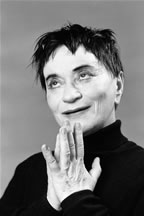
A wonderful series of photographs of Gert by Mark B. Astendig is available to look at here (the smaller photograph under the title is one of these outstanding photographs by Mark B. Astendig) http://anstendig.com/Valeska%20Gert/gert_page.html

Naum Kleiman's Talk at the Meyerhold Museum on Ivan the Terrible


One of my favourite places in Moscow is the Meyerhold Museum. It's rather rare to feel at home in the houses of famous writers and artists but for some reason Russia is an exception. Chekhov's houses in Taganrog and Yalta, Tolstoy's estate in Yasnaya Polyana and the Mayakovsky and Meyerhold museums here in Moscow are places which I would happily revisit.

Returning to Moscow last week I realized that I will come to visit the Meyerhold Museum regularly this time. A series of lectures on Meyerhold's actors and film showings with introductory lectures are each held once a month. To my great regret I have missed those lectures held earlier in the year on Lev Sverdlin and the film 'By the Bluest of Seas' by Evgeny Margolit and other lectures by cinema scholars such as Andrey Shemiakin and Irina Grashchenkova (who, however, will return for another lecture next month on the film A Severe Young Man by Abraam Room) but yesterdays lecture on Eisenstein's 'Ivan the Terrible' by Naum Kleiman was so brilliant that I forgot what I had missed and just savoured the opportunity to hear the world's foremost Eisenstein scholar captivate the audience with a talk so wide-ranging that even Podmoscovia's lakes of melted snow, oil and dirt that greeted me on my walk home couldn't dim my spirits.

It is almost impossible to summarise a lecture by Naum Kleiman. It ranged from the importance of the frescoes, the quotes of Michelangelo's Sistine Chapel in the Eisenstein film, the difficulties of those actors who were trained by Stanislavsky had in playing in this film shot by Meyerhold's star pupil, the terrible curse that Ivan the Terrible would have on those who tried to turn the story into art (Kleiman suggested that Eisenstein knew that making Ivan the Terrible would become a fateful decision in his life), Eisenstein's use of colour, the siginificance of the gestures and the fact that this film was in many ways Eisenstein's homage to Meyerhold. Eisenstein never forgot his debt to Meyerhold - it was Meyerhold's archive that he took to Alma Ata for safekeeping during the war. Also, everywhere he went he would take a photograph of Meyerhold with him even though he would certainly be arrested had the authorities found about about this. Kleiman argued that Part Three of Ivan the Terrible could have lead to Eisenstein's arrest and possible execution given his determination to portray Ivan the Terrible (and hence Stalin) as a Lucifer-type figure. Unfortunately that which remains of Part Three is a very small segment. The culprit who destroyed those sequences of the third part of Ivan the Terrible is Ivan Pyriev who decided that Eisenstein had shot Ivan the Terrible 'incorrectly' and that Pyriev himself would show the real Ivan the Terrible to the world. (A crime against cinema similar to those of our contemporary, Mikhalkov?)

Kleiman is a scholar who inspires a fresh love for Soviet cinema and a realization that it is part of the universal history of cinema and art. The references in Ivan the Terrible to Michelangelo, the Japanese Kabuki theatre, to the opera Rigoletto show what a universal artist Eisenstein really was (as was his master Meyerhold). When he introduced the talk, Kleiman reminded the audience of a photograph of Eisenstein shot on the day of Meyerhold's murder (February 2nd 1940). Eisenstein in the photograph wears an expression of absolute gloom on his face as though he somehow had some intuition that this was the day in which his beloved master Meyerhold was to be cruelly executed. It is an irony of sorts that the only section that remains of Ivan the Terrible Part Three is a scene in which a German is being interrogated by a crazed Ivan the Terrible and his oprichniky. A scene which obliquely alludes to the Stalinist camps where one of the greatest theatre directors the world has ever known lost his life.

The photograph accompanying this article is one of Meyerhold playing Ivan the Terrible.

Friday, 19 March 2010

Victor Avilov and The Moscow Theatre of the South West


Just back in Moscow I headed for my favourite bookshop in town. Falanster, an anarchist, leftist bookshop with the lowest prices and best variety of books in Moscow. I immediately searched in the cinema section and found a new book of Yuri Tsivian's articles, and nearby I discovered a biography of the actor Victor Avilov. This took me back to 2001-2002 when I spent my first year in Moscow studying Russian at the Moscow State Pedagogical University with a small group of Chinese and South Korean students. This university was located not far from the Theatre Studio of the South-West and although I soon moved to the North West of the City in Kuntsevo there was a collective taxi (marshrutka) which would take me both to the theatre and to university. In spite of knowing little Russian, I went three or four times a week to the theatre and this particular theatre was my particular favourite. There were a number of plays I would watch spellbound even though not understanding much of the nuance of the narrative - sometimes I would return two or three times to the same play (theatre prices were extremely low at that time - two to four UK Pounds). The style of acting was so unlike other theatres in Moscow. Being such a small theatre it had an intimate feel. I now consider myself extremely fortunate to have been able to witness what in retrospect some consider one of the most extraordinary Russian theatre and film actors of the late twentieth century, Victor Avilov.

Unfortunately, little of Avilov's brilliance as an actor comes across in his cinematic roles. Perhaps only the flawed but interesting Gospodin Oformitel' (translated clumsily as Mister Designer) manages to portray the extraordinary qualities of the actor Avilov through which he realized hiimself and his roles in this theatre. The biography of Avilov by Natalia Staroselskaya is an interesting account of how he became such a spellbinding actor. The Theatre Studio of the South-West was a theatre which existed almost outside of the Soviet theatre system. More than Liubimov's Theatre on the Taganka (perhaps the theatre symbol of the generation of the 'shiestdesiatniki' (the sixties generation of the Thaw), it was a theatre of non-professional actors and managed to express (more than most other theatres) the ethos of a later generation in which the illusions of the Thaw had all died.

Victor Avilov was a lorry driver who had known the theatre director Valery Belyakovich's brother in his school years and had no professional training in acting whatsoever. The development of this actor from starring roles in light comedies and farces in the early years of the theatre to some great roles of absurd theatre(such as Ionesco's 'Rhinoceros') to tragic roles (including a splendid performance of Hamlet which was wildly received at the Edinburgh festival and was deemed by Japanese theatre goers to have been the very best Hamlet they had seen performed)is exceptionally well recounted by the author of this biography. Other great roles he was to play included that of Voland in Master and Margerita as well as Caligula in Camus's play of the same title. He, also, arguably helped to create one of the better recent productions of Gorky's 'The Lower Depths'.

Apparently the first mention of this theatre abroad was provoked by a visit to the theatre by a British photo-journalist who was to witness a fight outside the theatre. Former owners of the building were beating the theatre director Valery Belyakovich due to a dispute over the ownership of the building when out stepped two actors in female dress rehearsing for a farce(one of these 'transvestites' was Victor Avilov)and proceded to defend their owner with their fists. Apparently according to Staroselskaya this theatre then gained a small reputation in Britain as the theatre of Moscow's riff-raff.

One of the few mentions I have been able to find in the British press is an article by John Fowler in the Glasgow Herald from August 25th 1987 comparing it to Grotowski's Poor Theatre. Fowler describes the founding of the theatre, Belyakovich's insistence on using non-trained actors who had not moved through the Soviet theatrical schools and the collective and egalitarian ethos of the theatre but he was signally unable to quite understand much more of the principles behind the theatre - he calls Belyakovich a 'terse communicator' and said that Avilov was reluctant to discuss the subject of his transformation from lorry driver to becoming a world-class actor. The theatre found greater success in Japan where they would return to for many repeat tours.

My own memory of Avilov was his ability to completely hynoptise the audience and I remember that on my later trips (when Avilov acted more rarely) I was often disappointed that some of the plays lost their force without his entrancing presence- the Master & Margerita which I saw without him was, alas, a definite flop (although I have heard that most recently their production of this seminal work has improved). His greatest roles were arguably those of Voland, Hamlet, Caligula, and Berenger in Rhinoceros by Ionesco. I myself have memories of his unforgettable performances in Walpurgis Night by Venedikt Yerofeyev and in Dostoyevsky Trip by Vladimir Sorokin. His last cinema role was, apparently, that of Meyerkhold in a film by Semyon Ryabikov called 'Zolotaya golova na plakhe'.

Monday, 8 March 2010

Sergei Paradjanov


The BFI should be warmly congratulated for their excellent Paradjanov (or Paradzhanov) retrospective. Saturday an excellent symposium was held at the NFT with a whole list of guests including the Ukrainian-Armenian director and friend of Paradjanov Roman Balayan, the film historian and curator Ian Christie, the film-maker and producer Patrick Cazals, the Georgian photographer Yuri Mechitov, the writer, lecturer and broadcaster John Riley and others. The Symposium was full of different 'takes on Paradjanov from the scholarly to the often hilarious personal recollections of Roman Balayan. Ian Christie entitled his introductory piece A Fortunate Man which is a rather strange thing to say about a film director who spent years in the prisons of the Soviet Union. He went on, however, to justify his argument by saying how this might be true. Fortunate to belong to a generation of directors and to have such great opportunities at studying under the great masters in the Soviet Union's State Cinematography Institute (in the workshop of Savchenko where Marlen Khutsiev also studied), fortunate in being the recipient of a powerful international solidarity campaign when he was jailed and being eventually granted his release, fortunate in the ability to create such unique masterpieces which in the conditions of the Soviet Union could still be made if left on the shelf (and would probably never get the funding in the West for such esoteric films). Ian Christie explained how he had begun his filmmaking career in the deadening atmosphere of the late Stalin period. VGIK was at that time a refuge for the greats of Soviet cinema who had been left almost unemployed by the film famine years at the end of Stalin's life.

The consensus is that there was two periods in Paradjanov's film career. He himself would have pointed to his viewing of Tarkovsky's 'Ivan's Childhood' as the dividing point. For Christie the earlier film by Kalatozov 'The Cranes are Flying' was also a significant moment. Yet a viewing even of some of his early films suggest that Paradjanov was able to express stunning visual effects in his films with their rather conventional Socialist Realist plot lines (my viewing of Flower on the Stone convinced me of his superb ability to deal even with black and white and his use of chiaroscuro to maximum effect). His Shadows of Forgotten Ancestors had a fantastically wide distribution and success both in the Soviet Union and abroad. Its use of folklore, its stunning use of colour and his unique way of using music and dance (which was his original orientation, Ian Christie reminds us) makes the viewing of this film a rare and unforgettable experience. Yet in 1965 he was to move even further along the route of being a uniquely visual filmmaker and the remaining rushes of Kiev Frescoes (totalling about 13 minutes) indicate that narrative was to be subordinate to the need to make every frame painterly and artistic.

Layla Alexander-Garrett who was the initiator and organiser of this festival and who had worked with Tarkovsky, contrasted the two artists who had become such close friends. It was, according both to her and Ian Christie, a meeting of opposites. Tarkovsky personified almost absolute restraint and Paradjanov a heady exhuberance. What some believe to be Paradjanov's masterpiece - Sayat Nova (aka The Colour of Pomegranates) was to be made in the most difficult period to work in- the late sixties when so many films were banned. Ian Christie stated that it is a mystery how he actually came to make a film like this at all. The answer, it seems, is that it was made in Armenia (the more distant from the centre one was, the less the iron-grip of control by film bureaucrats) and although it was reedited by Yutkevich most participants agreed that Yutkevich simply wished to preserve the film and was a strong champion of the film (who was according to one speaker the film's only champion at the time). Ian Christie spent some time talking about the international campaign in Paradjanov's defence (after being jailed on a veritable cocktail of charges) by filmmakers and argued that a lot of the campaign came through western Communist Parties and Louis Aragon's intervention with Brezhnev as well as the involvement of those film-makers such as Fellini and Bunuel who played a significant part in his final release from prison. The world cinema tradition that speakers placed Paradjanov in were alongside film-makers such as Pasolini and Jarman in terms of a queer sensibility, but Fellini was also mentioned.

Nouritza Matossian argued powerfully to place Paradjanov within an Armenian perspective (and she posited similarities with Arshile Gorky). His belonging to the Armenian community of Tbilisi also influenced him as did the naif art of Pirosmani (although it was hotly disputed whether one could call Paradjanov a naif or primitive artist). She also emphasised how his idea of epic narrative was what distinguished his style from any remnant of socialist realism. She argued that there were always elements of surrealism in medieval Armenian art and that the major aspect of Armenian art that distinguished Paradjanov from other film directors was his frontality (something that also linked him to Cezanne as well as the reliefs of the Armenian churches). He also used a double language of symbols and builds up a kind of ark of symbols in his work which makes his films so rich in meaning.

For Yuri Mechitov Paradjanov was the first successful post-modernist. Roman Balayan was a great racconteur of Paradjanov tales. Balayan as he said wanted to prove that a genius was also a human being. He explained Paradjanov's love of inventing stories (believing that the truth was too boring), his absolute need for spectators and suggested that he would have made a wonderful circus clown. He told the story of how when Tonino Guerra visited Paradjanov and told him that he was a genius, Paradjanov replied that there was no need to tell him because he already knew and that Tonino Guerra should shout out loud in Italian to his neighbours from the balcony that Paradjanov was a genius. Paradjanov was not satisfied with Tonino Guerra's first attempt and told him to shout louder which poor Tonino Guerra consented to do. Balayan emphasised Paradjanov's love of company. He stated that Paradjanov had not a book in his house but loved going to the opera and although he never generally watched films he went to see a film by Pasolini (Oedipus Rex, I believe) 17 times. Yet Paradjanov's lack of books ignored the fact that he had written 20 wonderful scripts that it was hoped would be translated into English one day.

Elisabetta Fabrizi noted that Paradjanov's central goal was to achieve in film what visual artists had achieved with the flat surface of canvas. She points out his links to both Pasolini and Fellini and argued that Paradjanov was the most complete example of art giving shape in filmic language. She also explained how he created a different kind of temporality in his films and his use of the visual allowed him to transcend reality. She also tried to place the influence of the Russian icon on the film. How icon art was about abstraction and frontal and not like Renaissance Art an imitation of life. In Paradjanov's films each object brings its own reality to the film and is a protagonist for what it represents. She also tried to show how it reflected Persian miniatures in his construction of space in the film. Actors in his films represent type and not real characters. It was emphasised how Paradjanov worked consistently with Sofiko Chiaureli who might play up to six roles in the same film.

John Riley showed Paradjanov in the context of the collage art of Dadaism, Surrealism and Pop Art and the use of found materials. He also relates this to musical influences (of a mainly western orientation) but emphasises the notion of polystylism which was, for Riley, a part of the aesthetic style of the time. He gives the examples of collage films like Romm's 'And nevertheless I believe' with its found footage as well as Khrzhanovsky's 'Glass Harmonica'. He then talks about how Paradjanov uses the idea of asynchronicity that was first trumpeted in the joint statement on sound by Pudovkin, Eisenstein and others. The influence of Eisenstein the participants argued was a very important but undocumented influence.

Other interventions by Patrick Cazals on the bestiary of Paradjanov and Daniel Bird on the state of copies of Paradjanov's films. Alas, Bird's contribution highlighted some worrying facts about how badly preserved these copies are and how little cooperation there has been between film archives and studios in different parts of the former Soviet Union. Paradjanov's dispersal was illustrated in the form of a joke about why he was imprisoned. He stated that he was an Armenian born in Georgian who was jailed by the Russians for being a Ukrainian nationalist!

Friday, 26 February 2010

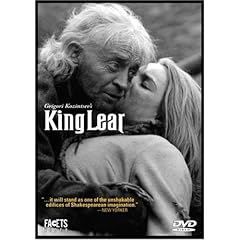
Kozintsev's Korol Lir (King Lear)


Last weeks Times Literary Supplement came out with an article praising Kozintsev's Korol Lir (or King Lear) as the adaptation on stage and screen "closest, not just to the radical energies of Shakespeare's play, which interrogates the political uses of land, but also to our own twenty-first century fears and preocupations about what we do to the land - and what it does to us". An interesting article which calls for the reappraisal of this fascinating film that was made on the cusp of the period between the end of the thaw and the setting in of Brezhnevian stagnation.

The article by a trio of authors (Richard Margraf Turley, Howard Thomas and Jayne Elisabeth Archer) argues that the vision of Kozintsev was much closer to Shakespeare than that of Peter Brooks due to its acknowledgment that Shakespeare's play is an arable play. A powerful argument is made by the authors but this is marred by some really silly lapses of judgement and factual howlers. Stating that "situating some of the play in a plain by the Caspian Sea ... (Kozintsev) brings to play his own childhood memories of disease and famine under Stalin" is alas a real howler - Kozintsev was a well-established film director under Stalin and no child! Equally calling Kozintsev a dissident film-maker is giving a whole new meaning to the word dissident which it simply doesn't have. Kozintsev definitely wasn't a mouthpiece for state ideology and managed to carve out his own autonomous space but no, he wasn't a convinced disident a la Solzhenitsyn either. In spite of these qualms it is nice to read an article evaluating a Soviet film so highly as being the closest adaptation of Shakespeare.

A clip from the end of the film is shown. The script of the play is from Pasternak's translation and the soundtrack is Shostakovich's. Can't get much better than that.

Thursday, 25 February 2010

Two paintings by Telemaco Signorini & Ilya Repin


Not a cinematic post but during a visit to an exhibition at the Palazzo Zabarella in Padua I was struck by a painting which would immediately bring to mind a classic Russian painting. The Italian painting L'alzaia (upper painting)is by the Italian 'Macchiaiolo' painter Telemaco Signorini and the classic Russian painting (lower painting) is, of course, by Ilya Repin and one of Russia's most famous paintings 'Barge Haulers on the Volga'. The Italian painting dates back to 1864 and Repin's was carried out between 1870-1873. Telemaco Signorini is considered the most European of the Macchiaiolo school. He also lived some time in the Cinque Terre village of Riomaggiore.

Vladimir Motyl


Vladimir Motyl died recently at the age of 83. Known above all for his classic Eastern 'White sun of the desert' (denounced at the time as a counter-revolutionary film) and his bitter war comedy 'Zhenia, Zhenechka and Katiusha' (also running into problems with the censors) he gained a truly popular success. Andrey Shemyakin has written an interesting article on his blog linking Motyl to the eccentric tradition in Russian film (from Barnet to the FEKS circle of Kozintsev and Trauberg) as well as situating him in a trio of directors - Savva Kulish & Gennadi Poloka being the other two - who managed to break out of the sixties reigning aesthetic.

Motyl made a mere ten films in his fourty year career but he is known by the public for those two mentioned above and in more recent years has had little popular success. The youtube clip shows the beginning of his film 'Zhenia, Zhenechka and Katiusha'with English subtitles.

Soviet Cinema in Italy


A month in Italy left me with ample time firstly for a visit to a film festival in Trieste, secondly for watching some of my DVDs that I left there and thirdly to read some of my Italian collection of books on Soviet culture and cinema. I have always been curious as to the different approach and different reception that Soviet cinema and culture has had in Italy as compared to Britain. An obviously minor topic but a curious one nonetheless and one which would need an amount of research to draw anything but merely impressionistic conclusions. Yet there are some fascinating stories linking Italy with Russian and Soviet cinema. One of course was the story of Francesco Misiano who I blogged about a few months ago - someone who played a not insignificant part in the very history of Soviet cinema.

One of the people most associated with the discovery of Soviet cinema in Italy was Umberto Barbaro (pictured above) - one of the main figures in Italy's 'Experimental Centre of Cinematography' which existed during fascism but then was to create a whole generation of anti-fascist Neorealist filmmakers and be a refuge for staunch anti-fascists like Barbaro even during the fascist period. Barbaro was to translate the writings of Pudovkin and Eisenstein after the second world war and become the first great film scholar to bring Soviet cinema to the attention of the Italian cinema world. It is curious, though, that even during the 'ventennio' (the period of fascist rule) Soviet cinema entered fascist Italy -for example, at the Venice Film Festival in 1932 & 1934- Ekk's film 'A Voucher for Life' (Putyovka v Zhizn') enjoying particular success. Even specialised reviews devoted considerable space to Soviet cinema so it can't be said that there was a total absence of cinematic links.

It was, of course, only after the second world war that Soviet cinema could, however, be more openly available to a larger public. This was, perhaps, not the most propitious time for this to happen. Late Stalinist cinema was suffering its film famine and, alas, producing some of its least appealing "lacquered" films and those like The Vow (Kliatva) and The Fall of Berlin (Padenie Berlina) in which Stalin appears as a demi god-like figure. Yet culture in immediate post-war Italy was a highly politicised sphere and the Cold War played a more significant role in Italy than elsewhere. There is, apparently, a review by Italo Calvino defending these films. The role of cinema clubs is another interesting story and again one in which politics played its part and the Cold War determined to a large degree how Soviet cinema was received. Another film scholar, Guido Aristarco, will appear on the horizon and will develop a Marxist approach to film criticism and will be as much a champion of Eisenstein as Barbaro was for Pudovkin (he was also referred to by Luchino Visconti as the "most Viscontian of critics").

The greatest interpreter of Russian & Soviet cinema in Italy was Giovanni Buttafava whose knowledge of Soviet cinema was phenomenal (the great Russian critic Naum Kleiman painted a wonderful portrait of Gianni Buttafava in his introduction to his interviews with Bernard Eisenschitz). Almost as fascinating were characters like Gastone Predieri who Enrico Ghezzi characterised as "the man with the projector". Predieri made sure that the Association Italy-USSR would have one of the largest stores of Soviet films in Western Europe. In fact even today searching on youtube, clips of rare Soviet films regularly appear with Italian subtitles. Enrico Ghezzi's role as conductor of Italy's mythical 'Fuori Orario' (a late night TV programme that runs from 2 am to 6am and which shows all the films that are nowhere to be seen or found elsewhere- among which hundreds of hidden Soviet classics have been shown on Italian television).

These are some of the names of Italian scholars and film professionals who have brought Soviet cinema to Italy. 'Film professionals', though, is a misleading characterisation of these characters- there is a passion mixed with 'fanaticism' in these characters that is rarely seen in the Anglo-Saxon world - or rather Italian history has shaped a less academic and more 'passionate' relationship between the world of Soviet cinema and Italian interpreters of this world. The reception of Italian cinema was both more politicised but also more possible outside a purely academic sphere because the greater amount of possible links during the Cold War through the Italian Communist Party. Yet discovering more in this realm is a subject for further research.

Wednesday, 24 February 2010

Henri Cartier Bresson's Soviet Photographs Exhibition in Genoa's Palazzo Ducale


Staying in Liguria usually means a weekly visit to Genova (or Genoa as it is written in English). I love the description given of the city by one of Chekhov's characters in the last act of The Seagull who when asked (as someone who has travelled everywhere in the world) which city is the best city in the world to live in replies Genoa because it is only there that one feels the presence of a world soul. Chekhov only very briefly visited Genoa so I am not sure if this was his genuine feeling about the city. My own love for the city grows each time I visit.

This visit was rewarded with a very special treat. Genoa has a splendid record of Russian themed exhibitions - significant ones have been a large exhibition in 2001 on major Russian artists who have lived & painted in Liguria, another one on Soviet avant-garde arists and this time an exhibition of Henri Cartier Bresson's photographs of the Soviet Union during two trips there in 1954 and 1972/3. The exhibition included photographs from Moscow, Irkutsk, Georgia, Kyryzstan and Baku. For me the real revelation was those photographs he took in 1954.

My favourite was of a street scene near a tram stop (it is the photo rather badly reproduced here). In the right-hand background there is a tram and some passengers alighting, in the left background a seller of kvas. In the foreground are two 'milliotsionery' smiling and glancing in different directions - one appears to be looking at the two young women at the very front of the photograph. One of these women has her back to the camera but her head is turned so that her expression is clearly visible, the other woman is looking elsewhere. There is a sense that they are pausing for thought. The woman whose front is towards the camera is holding a small case and they are both wearing sandals. Cartier Bresson has managed to capture something special in this photograph and in many others of Moscow and elsewehere in the Soviet Union. A moment of life, something which it is nearly impossible to discover in Soviet cinema of 1954. For me the best scenes of street life can only be found in Khutsiev's 1967 movie 'July Rain' at the very end when he is filming a veterans meeting on Vitory Day (May 9th) or perhaps some of Romm's closing street scenes at the end of his documentary 'Ordinary Fascism' even though to me they don't generate the charm that Cartier Bresson or Khutsiev captures.

In the exhibition were some other splendid photographs. A wonderful street scene in Baku with children, a scene near Kazansky Train Station with a line of taxis, flower sellers and an elegantly dressed womansurprised by the camera. Cartier Bresson manages to capture some wonderful facial expressions. Other splendid photos are of the Metropol Hotel canteen for workers with its 'doska pochyota' portraits of Lenin and Stalin(this was 1954) and the various workers; another photograph that was amongst the best was of a shop assistant demonstrating a single bag to six or seven female customers- the eyes of these customers all fixed on this single handbag. A fascinating portrait of the human face.

All in all a real documentary of the Soviet Union of 1954 (and also of the early seventies) rarely fixed in Soviet film of that time. Genoa's excellent exhibitions of Russian and Soviet culture has made it an excellent showcase as to what can be done to promote real cultural ties with Russia.