Total Pageviews

Monday, 10 September 2012

Cigarette Girl from Mosselprom and a view of Moscow in the 1920s


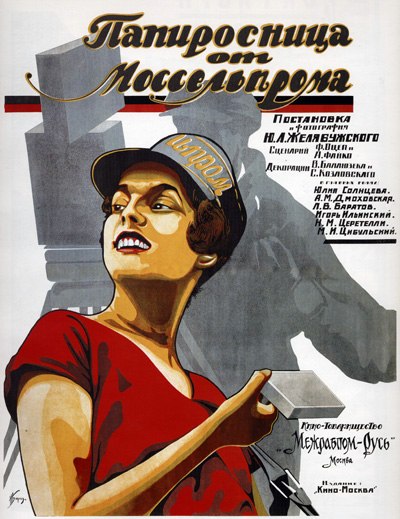
In a Moscow which seems determined to wipe cinematic memory from itself - after the closure of Musei Kino in 2005, it is uncertain what exactly has happened to the Iluzion cinema (ремонт? - but then why so soon after it had been repaired a few years ago). Dom Khanzhankova has been turned into a restaurant. So it is now clear that the only place where one can see old Soviet films are in those few places which will show them on DVD in not very excellent conditions. The only reason one should go along to see these are often for the talks that accompany them. This Saturday there was an excellent talk in a small bookstore near Chistye Prudi named Читалка and a showing of the newly restored copy by the Toulouse and Bologna Cinemateques (alas yes on DVD) of Yuri Zhelyabuzhsky's film Папоросница от Моссельпрома (The Cigarette Girl from Mosselprom, 1924).

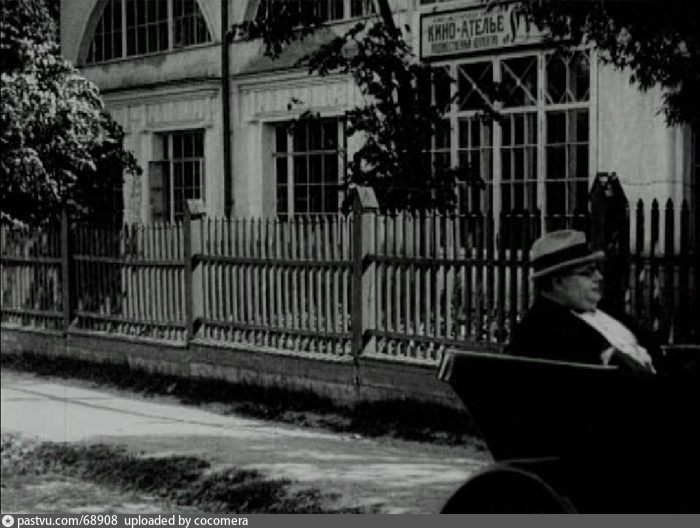
Apart from this being one of the most enjoyable comedies of the Soviet silent era this film is a delight in many ways and, apart from telling us much about cinematic developments in the early 1920s equally allows us to retrace and recapture a lot of the lost Moscow that was later demolished in the Stalinist period and beyond. And it was this aspect which really shone in the talk given. Tens of cadres from the film were shown as images of places no longer there or transformed beyond recognition. For a cinephile perhaps the most fascinating shots were those of the Mezhrabpom-Rus studios shot both from the outside and the inside. Here is a still of the American businessman McBride driving past the studio in the film based near Верхняя Масловская (Verkhnyaya Maslovskaya Street):


The whole film, in fact, helps one to reconstruct a view of 1920s Moscow. This has been done in the excellent post in the Russian Progulkino blog here . The film itself was one of a number of Soviet films which were ordered as pure advertising - in this case for the Moscow state concern uniting various food suppliers and distributors. Others included Protazanov's Закройщик из Торжка (The Tailor from Torzhok, 1925) and Barnet's Девушка с Коробкой (The Girl with the Hat, 1927) which were both advertising films for the state lottery. The mystery of how advertising could produce such excellent films is, perhaps, an indication of the strange times of the Soviet 1920s. 

That Soviet advertising could employ no less a pen than that of Vladimir Mayakovsky and the art work of Aleksander Rodchenko means that it is a world well worth exploring. It was to be Mayakovsky's pen that coined the most famous advertising slogan for Mosselprom Нигде кроме, как в Моссельпроме (Nowhere else but in Mosselprom) and he would work for Mosselprom coining a whole host of advertising slogans from 1923-1925- they are available in Russian here

Rodchenko would work alongside Maykovsky in designing some of the advertising posters for Mosselprom such as this one hear which carries Mayakovsky's famous advertising slogan:
A collection of Soviet advertising posters (including some from Mosselprom) is available in this blog post here

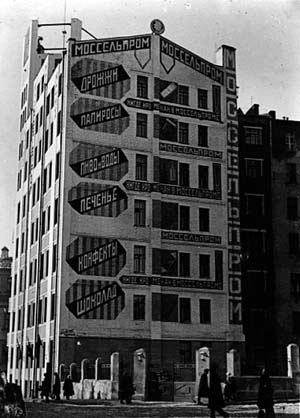
The Mosselprom building still stands with the original advertising as a comparison between a Rodchenko photo and a contemporary photo demonstrates


Nearby was located the great Proletkult theatre located in the building known as the Osobniak Mamontova. Here is a still from the film passing by the Proletkult building and then a photo of how the building looks today


The youtube video of the film at the top is, unfortunately, not the fully restored version but a shorter version available previously.

Here is Rodchenko's photograph of an actual cigarette girl in Staraya Ploshchad:

Tuesday, 4 September 2012

Igor Kvasha 1933-2012.


One of the founding members of the Современник (Sovremennik) theatre, Igor Kvasha was one of the symbols of a generation of actors who played a significant role not only in theatre but also in cinema as well as being in many ways the conscience of the shestidesiatniki (the sixties generation). Kvasha was one of the most active in terms of his willingness to stick his head out in terms of politically difficult subjects. As Lia Akhedzhakova notes in an interview with Novaya Gazeta Akhedzhakova on Kvasha, Kvasha was the first to sign letters in defence of jailed Soviet dissidents such as Sinyavsky and Daniel and at one point was refused exit after he had embraced the exiled writer Viktor Nekrasov in Paris and spent some hours in his company (word soon got round to the security services). Kvasha was also one of the hundred cultural and intellectual figures who recently signed a petition to release Pussy Riot. His civil engagement was clear, too, in his call last December of support for mass demonstrations against the political system Kvasha on Sakhraov demo

His acting career was synonymous with the Современник theatre where he remained from its foundation until his final days - the theatre being one of those symbolic spaces in the Soviet Union where one could find views that challenged the dominant view of things and the dominant ideology. In film he played in over 70 roles. He considered his own best role to be that of Stalin (who he played various times) in Под знаком Скорпиона (Under the Sign of Scorpio, 1995) about Gorky after the October revolution. In fact, Kvasha played Stalin in a number of productions and Kvasha through playing the role seemed to be searching for an understanding of as he put it Stalin's "psychology and how he could subjugate a whole country and with what methods and what he did to achieve this" (меня всегда интересовала эта психология и то, как он смог подчинить страну. Какими методами? И что же он сделал для этого?). Kvasha would always try to find out from people who knew or had met Stalin answers to these questions.

Kvasha also played in many very popular films such as Mark Zakharov's Тот самый Мюнхгаузен (That very Munchhausen, 1979) alongside the great Oleg Yankovsky and Челове́к с бульва́ра Капуци́нов (The man from the Capuccin Boulevard, 1987), the immensely popular Western parody based on the subject of the birth of cinema. He worked with such great directors as Elem Klimov and Sergei Yutkevich and with Andrej Wajda in the latter's production of Dostoyevsky's Бесы (The Possessed) at the Sovremennik Theatre. 

Alek Epstein's 'Art on the Barricades'


Alek D. Epstein's book/ album on Pussy Riot seems finally to have hit at least one or two of Moscow's more radical bookstores and I've finally had a chance to have a look. The story of how the album had its own difficult passage into actually being published has been briefly told in a blog in one of Russia's art magazines Art Khronika http://artchronika.ru/blog/epstein-pussy-riot/ Apparently, three printing presses refused to print it and another to bind it, so it's nice to finally have the opportunity to hold the book in my hands. It even took some time before the book appeared in the bookshops (a bookseller a few weeks ago told me that there were some 'distribution problems', though of what order he didn't elucidate).

As an 'instant book' it obviously doesn't have the deep analysis of the Pussy Riot phenomenon that can only come after some time. Epstein is clearly what in sociology used to be called 'a participant observer' (he has close links with the actionist art groups from which Pussy Riot sprung and with two of the Pussy Riot members themselves). There is no doubt that he both wants the book to serve as a kind of homage to Pussy Riot as well as an act of solidarity in addition to offering some kind of historical context as well as a chronicle of recent events.

For me the most interesting part of the book was the section on the way religious symbolism has been used in art and his analysis of the actual 'Punk Prayer' that was sung at the Cathedral. The section on the symbolic use of the Madonna or Virgin Mary in art gives a few fascinating precursors to the lines calling for the Madonna to become a feminist and to 'chase out' Putin. He alludes to paintings such as that of Max Ernst's  Madonna spanking the child Jesus in front of three witnesses, as well as Edvard Munch's litograph of the Madonna with foetus and spermatozoa near the frame and more recent artworks by Giuseppe Veneziano with his Madonna of the Third Reich with an Adolf Hitler in the arms of an Aryan Madonna and Oleg Kulik's shahidka terrorist Madonna of 2005. This concept was to lead Israeli artists Galina Bleikh and Lilia Chak to a similar idea in their sensational Ferror (Female Terror) 2009 exhibition which was then cancelled due to protests from family victims of terror attacks.

Epstein also talks about the symbolic nature of some of the 'venues' of Pussy Riot performances - such as Lobnoye Mestoe (or the Place of Skulls) which was also the venue of the 1968 protest against the invasion of Czechoslovakia. 23 years later it was to be the site of Anatoly Osmolovsky's 1991 action inspired against the 'Moral Law' banning swearing in public places alongside his art group E.A.T. (Expropriation of Public Territories) as well as other more recent more politicized actions for the release of political prisoners. The Cathedral of Church the Saviour was also the venue for other actions in protest against church-state collaboration or religious fanaticism including some by Femen and Oleg Mavromatti (for which the latter was made effectively stateless after the Russian consulate refused to renew his passport telling him that he was on their international wanted list).

Another section of the album is devoted to the Autobus Exhibition in favour of Pussy Riot during the trial. As Epstein points out this was also historically based on the well-known Bulldozer Exhibition in the 1970s in which informal and underground artists displayed their work, an exhibition which was then to be bulldozed and its artists dispersed with water cannon in 1974. Furthermore he details the many actions and art festivals which were carried out in support of Pussy Riot up until the month of June including the Artists Walk and the collective letter of the intelligentsia who called for the members release.

However, what the book is perhaps to be most valued for are the reproductions of photographs and art work of these events and happenings and the numerous posters and internet artwork produced for the release of these three artists. The publisher of this book is Viktor Bondarenko and the art group 'Россия для Всех' (Russia for all).

An illustrative blogpost on The Madonna in Radical Art is on my other blog - here is the link Madonna-before-pussy-riot/

Sunday, 26 August 2012

Marlen Khutsiev and the Unknown New Wave


A recent viewing of Marlen Khutsiev's Застава Ильича (Lenin's Gate) has convinced me once again that the fact that film scholars speak of a French New Wave, a Czech or Polish New Wave, New German Cinema or even of the Yugoslav Black Wave and even that some acknowledgement in recent years has been given to Spain's subversive but operative New Wave under Franco (with a BFI retrospective in London two or three years ago) and yet have still not acknowledged the work of certain Soviet directors in the 1960s and 1970s is a gaping hole. Of course, the Poetic Cinema of Tarkovsky and Paradjanov has justifiably been given a lot of international attention and yet there are still a whole host of directors which have passed many international film critics by. Having to choose the most important names of this other Soviet New Wave I would argue that the names of Marlen Khutsiev, Vasili Shukshin, Elem Klimov and Kira Muratova are paramount. Khutsiev and Shukshin are arguably those who have had least exposure in Western Europe of the four- although at least Shukshin has had some of his literary works translated.

Marlen Khutsiev, a Tbilisi born Soviet (and then Russian) filmmaker, has in many ways been unusually unfortunate in making films in the wrong time and at the wrong place and yet his films are some of the most strikingly original portraits of a generation and Khutsiev also occupied a rather unique position- both intellectually (or ideologically) and cinematographically in the Soviet constellation.

Khutsiev began work with Feliks Mironer first in a diploma film at VGIK in 1950 and then at the Odessa Film Studios with probably what was to be Khutsiev's most popular film Весна на Заречной улице (Spring on Zarechnaya Street, 1956). Khutsiev had worked for some time as an assistant director for a number of directors including the legendary Soviet director Boris Barnet for his ill-fated Лиана (Liana, 1955) alongside another director to become famous in later years - Leonid Gaidai. However, the management at the Odessa Studios still didn't trust Khutsiev to make a film on his own and he had to co-direct with Mironer once again. While the film was subjected to some harsh criticism, it soon became seen as the first real sign of the Khruschevian Thaw. All the same Khutsiev was to remain in Odessa to film his next film Два Фёдора (The Two Fyodors, 1958) which was to introduce to Soviet cinema the acting skills of Vasili Shukshin.

It was Khutsiev's next film Застава Ильича which was to really show Khutsiev's true talents but also to highlight his fundamentally unfortunate and untimely nature. This film which, in many ways, was the film-symbol of the Thaw came at just the wrong moment when Thaw aesthetics and the liberatory potential of the Thaw itself was under attack. Alongside the ill-fated Manezh exhibition of contemporary art and Pasternak's novel 'Doctor Zhivago' this was to be one of the artistic victims of Khruschev's wrath. In fact, Khutsiev and his film had earned a very public lashing in March 1963 with the Communist leader inviting 600 artists and writers to the Kremlin to hear this very denunciation. Khutsiev was accused of promoting : ideas and norms of public and private life that are entirely unacceptable and alien to Soviet people. [...] [The characters] are not the sort of people society can rely upon. They are not fighters, not remakers of the world. They are morally sick people [...] The idea is to impress upon the children that their fathers cannot be their teachers in life, and that there is no point in turning to them for advice. The filmmakers think that young people ought to decide for themselves how to live, without asking their elders for counsel and help.

What seems to have provoked Khruschev's special wrath is the fact that, for the first time, the generation gap is being shown as part of Soviet as well as western bourgeois societies. In some ways a contemporary film viewer would be hard pressed to find some truly radical features of the film and yet this was a film that was, in many ways, truly ahead of many of its western counterparts. It managed to merge one of the most lyrical portraits of Moscow in the Thaw period with something very much more in the spirit of European cinema a la Antonioni. In fact one of the most intelligent (and harshly negative) criticisms of the film was precisely this - its western modernism and the antagonistic relationship between city and alienated protagonist (this was a criticism uttered by Alexander Macheret) captured as Antonioni had captured this in his films like La Notte or L'Eclisse - almost exact contemporaries of the Khutsiev film.

Khutsiev's extraordinarily lyrical film nonetheless posited him in a strange relationship to the Soviet intelligentsia. In many ways Khutsiev's position seems to be similar to the the main protagonist of the film, Sergei. His alienation from the tusovka at the party towards the end of the film marks, it seems, something of Khutsiev's gravitas. Khutsiev was no dissident and never turned into a liberal. He could never quite find an appropriate place in the polarization between mainly liberal intelligentsia and a power elite which increasingly betrayed any socially progressive ethos. His protagonists in Lenin's Gate, remained of proletarian origin and, as even his subsequent Ию́льский дождь (July Rain, 1967) shows, Khutsiev remained a filmmaker rather obsessed with the meaning and the lasting presence of the theme of the Great Patriotic War (or World War Two) in Soviet society. The presence of the ghost of Sergei's father was a scene that particularly grated on Khruschev and yet it was surely what he most clearly misunderstood. The even more Antonionian July Rain further closes with a memorable scene of war veterans meeting up at Victory Day celebrations and this scene is surely key to the film. Khutsiev for all him fixing his gaze on the alienation of the young thaw generation never questioned the fundamental values of Soviet society.

The war and generational question were crucial respectively to two subsequent films of Khutsiev: Был месяц май (It Was in May, 1970) and Послесловие (Postscript, 1983). The discovery by Soviet soldiers who are stationed in Germany at the end of the war in May 1945 of a nearby Nazi concentration camp makes this film quite unique in uncovering this rarely mentioned subject but also in taking Soviet films about the war in a very different direction to which they normally lead. I remember watching this film at Moscow's Dom Kino seven years ago on Victory Day and thinking to myself what a radical choice the programme co-ordinator had made by choosing this film rather than any others that day. Radical because Khutsiev would never shy away from asking harsher questions than others and because he never takes refuge in any type or form of cynicism which those who believed less sincerely found it far easier to do.

Khutsiev's ability to cut through all the rhetoric has hardly ever made him a popular film director (only his debut film made him a household name). Films like 'July Rain' and 'It was in May' and his 1991 film Бесконечность (Infinity) can only too easily be denounced as boring and they often were so denounced even by rather intelligent critics, although years later they appear as some of the most truly authentic filmic documents of their time. They have always, it seems, pointed to hidden truths that few others had the courage to utter at that time. 'July Rain' became the one great document of the transformation from Thaw to Stagnation as 'Lenin's Gate' has since become to be seen as the very best portrait of a generation which lived through the heady times of transformation. Khutsiev's filmography is very limited in quantity and he almost fell silent after the Thaw. He seems to be a once a decade filmmaker. For all this the imprint of the times has rarely been so brilliantly captured and the gravity of message rarely so sincerely uttered as by one of Russian (and Soviet) cinema's most significant figures.

Khutsiev remains unfortunate and even now not a 'timely figure'- the truly shabby treatment he received in recent years at the behest of Mikhalkov and his band of 'national-patriotic' thugs will surely go down in Russian cinematic history as one of the most shameful episodes of recent times. Khutsiev's untimeliness nonetheless will surely make sure that his contribution to Russian cinema will become one of the most long-lasting and his films will remain while others will be forgotten.


Thursday, 23 August 2012

The Return of Film Censorship to Russia?


         The long campaign for 'moral' cinema seems to be bearing fruits with the decision not to allow the Serbian film 'Clip' any film license in Russia. While the film has already been shown at both the Moscow and Odessa Film festivals it seems that it could be the first real target of outright censorship of a film in contemporary Russia. The head of the Film Union, Andrei Proshkin, has called on the Ministry of Culture to give it a film license albeit with understandable age limits. The Rotterdam Festival-awarded film has been blocked due to a law protecting children from information causing harm to their health and development, although this seems absurd in the light of differential age limits for cinema goers. According to Andrei Proshkin this decision by the Minister of Culture violates the Russian Constitution. It seems pretty clear that this decision must be understood in terms of the context of a battle for a so-called 'moralization' of cinema. This has been going on for some years now and the recent open letter of a group of anonymous young cinematographers published at the start of this years Moscow Film Festival attacking what they deemed to be 'negative' films was a further sign of this conservative campaign. The targets of negative films are rather varied - although the moralizers seem to enjoy attacking films that appeal to any large European film festivals. Stanislav Govorukhin has been on record stating his dislike for Sigarev's Жить (Living)- also shown at this years Rotterdam Festival. (It has finally been released in Moscow but is only showing at a single cinema in the city at 10pm proving once again how the most talented filmmakers In Russia today are also the most marginalized figures in Russia today). A further fillip to the 'Moral Majority' type-campaign was given by President Putin last November when he talked about the opportunity of bringing a Hays Code to Russia stating "I believe it's a good idea to use this positive experience and create a similar code of internal ethical standards for the Russian film industry". Now it seems to be clear where all this talk has been heading.

Speculation is rife about where this will new thirst for censorship will lead. The next test case may be another Serbian film Парад (Parade) which could well fall under the banning of so-called 'homosexual propaganda' in St. Petersburg. This would be a truly absurd case as the film is a light comedy and garnered a huge amount of public enthusiasm at the recent Odessa Film Festival. One can only marvel at the irony that Russia is returning to censorship by banning not American films but Serbian ones- one of the countries that it always sees as closest politically and culturally to itself.

In terms of the rhetoric that is coming from cultural conservatives in Russia at the present time, it would be sufficient to quote from an opinion column by the main editor of Культура (which was once the mouthpiece of the progressive Russian intelligentsia). Elena Yampolskaya, the most vociferous cheerleader for Nikita Mikhalkov in his former struggles with the Cinematographers' Union, had this to say about the open letter of Russian cultural figures calling for leniency in the sentence on Pussy Riot:

Всякий, кого втягивают в войну против Церкви, должен осознавать, на что идет. Если культура начинает бороться с верой ...кому нужна такая культура? Не оставить ли ее в PRоклятом PRошлом?  

(All those who engage in a war against the Church should recognize where this is leading them. If culture begins to struggle against faith ... who will need this culture? Won't it be left in the accursed past).

Yampolskaya's article as a whole can only remind one of Stalinist rhetoric at its very worst and her list of enemies include even those like Evgeny Mironov and Chulpan Khamatova who months ago were supporters of Mr Putin's Presidential bid. The thirst of today's мракобесы seems unlikely to be satiated by single acts of censorship. Rather any culture which does not portray 'Orthodox values' are likely to come under ever more heavy artillery fire from the cultural commissars of the Church.

P.S. 27/08/2012  The daily Коммерсант has just published a rather detailed article by Andrei Plakhov on the situation around Clip giving some more general information about the history of censorship in Russia and abroad. Plakhov gives a full explanation of why the censorship has no legal or cinematographic justification and then moves on to discussing cases of censorship in film history. He talks about the Hayes Code and also gives the examples of three Italian films - Fellini's La Dolce Vita, Pasolini's Salo' and Bertolucci's Last Tango in Paris. He then goes on to talk about the attempt to censor an unsuccessful attempt to censor a  Romanian film in Italy Francesco by Bobby Paunescu which was said to offend both the city of Verona (calling it a shit city) and the granddaughter of Benito Mussolini (calling her a whore). The lawsuit was thrown out of court.

The only recent cases where films where censorship attempts were made in Russia were to do two films which had scenes which irritated the Presidential administration. In Ilya Khrzhanovsky's film 4 reference is made to the drinking habits of the President's wife, whereas in Pavel Bardin's film Россия 88 (Russia 88) a portrait of Putin is turned round to show a portrait of Hitler. Both films struggled for some time to receive any license.

Plakhov, however, links this censorship with another scandal in recent Russian history when the Russian Orthodox Church in 1997 cried scandal when Scorsese's The Last Temptation of Christ was shown on Russian television at Easter. The situation around Clip appears to be a harbinger of a new cultural politics whereby the Ministry of Culture will have as its main partner, the Russian Orthodox Church. This taken to the absurd logic would end up censoring the whole of the present Russian New Wave and half of the masterpieces of contemporary cinema concludes Plakhov. The article in Russian entitled The last temptation of Mincult can be found here: http://kommersant.ru/doc/1996995

P.P.S. 28/08 - A further article by Yuri Gladilshchikov in the 'New Times' has been published http://newtimes.ru/articles/detail/56303 - I've given an English-language summary of it on the GiuVivRussianFilm Facebook page here http://www.facebook.com/GiuVivRussianFilm

Wednesday, 22 August 2012

Moscow's Central Studios of Documentary Film At Risk.


In yesterday's copy of  the newspaper Вечерняя Москва the main headline was about the terrible state that the 'Central Studio of Documentary Films' has found itself in. While in the 1990s the archives, phonoteques and soundteques of the studios managed to be salvaged by the studios staff, this priceless archive has come under a sustained assault in the past few years from which seem to be a number of anonymous organizations involved in raider capitalist practices. The newspaper reports how the studios original premises in Likhovy Pereulok were turned over to the Russian Orthodox Church in 2005. They then were situated at the RIA Novosti offices and in 2009 were given a new building in 2009. However, they were not the owners of this building and since then matters have gone from bad to worse.  The owners of the building - a Car Repair Centre of the Ministry of State Property- seem to have let out the building to some shady organizations which have hassled and made the work of the studio impossible. The situation has got so fraught that it almost turned violent  at one point. The unique archives which include, for example, a copy of the Oscar winning documentary film Разгром немецких войск под Москвой (Moscow Strikes Back) are under threat of being destroyed. According to Vitaly Mansky, the documentary filmmaker, the tragedy happened in 2005 when the studio was thrrown out of its premises in Likhovy Pereulok where a large documentary centre could have been built, inviting other documentary studios there and where a documentary film festival could have taken place. Mansky calls what happened a crime and that the fact that the studio is still somehow alive today is for him a miracle. Although commercial interests seem intent on dealing the final blow while the bureaucrats vilely utter their formulas. A sad tale of how church cupidity has added one more blow to the world of culture.

Sunday, 12 August 2012

My Bright Lights Review on the Moscow and Odessa Film Festivals.

My Bright Lights Review on the Moscow and Odessa Film Festivals has gone live on the internet so here it is http://www.brightlightsfilm.com/77/77moscow-and-odessa-2012.php
The editor of Bright Lights film Gary Morris introduces it thus:

Festivals get their due this go-round with a vibrant review of this year's Moscow and Odessa Film Festivals, written by Giuliano Vivaldi with an eye on both Russia's rich past and its dubious present. 

Plenty more to read there - including the fascinating story of Gore Vidal's banned Variety interview - Gore Vidal's misgivings about the Party of God seem pretty contemporary warnings sitting in Russia August 2012.  

Thursday, 9 August 2012

The film scripts of Nikolai Erdman.


In spite of his doomed theatrical career cut short by repression and censorship, Nikolai Erdman must surely be the greatest Soviet playwright. His two major plays - Самоубийца ( The Suicide) and Мандат (The Warrant) - were, in retrospect, genuine miracles. It is a cause for considerable mourning that Erdman's theatrical career was cut short by political repression and his subsequent marginlisation. Yet there is one area which greatly benefitted from Erdman's misfortune and that is that of film. Erdman was to become one of Soviet cinema's greatest scriptwriters and now finally Erast Garin's wish that Erdman's film scripts be collected and published is coming to fruition. The St Petersburg magazine and publishing house Seance are to be congratulated for this. Even though this volume doesn't include every single script, a small bu significant selection of them allows us to appreciate the genius of this great playwright.

The collection begins with Митя (Mitya)- a film script written at the same time as Erdman's play Самоубийца. While they are very different in many ways they are both attempts to create a new form of Soviet tragicomedy (with the film leaning closer to comedy and the play veering to tragedy). The fact that no copy of the film is extant is truly regrettable offering us another of those tantalising lost masterpieces that litter the history of Russian & Soviet cinema. Initially the director of the film was to be the great theatre director Vsevolod Meyerhold and Erdman was to play in the main role - so as well as tantalising us with the existence of a lost masterpiece one is tormented by trying to imagine how Meyerhold would have created yet another great film and how Erdman would have been captured for posterity. Later though it was Nikolai Okhlopkov - a Meyerhold renegade (or at least this is how Meyerhold saw him) who was to take both the role of both director and main actor.

After Митя, Erdman was one of the many great writers who were to work on Boris Barnet's Дом на Трубной (The House on Trubnaya Square). It is hard to say what exact part Erdman played in the making of the script for this masterpiece - it was a script worked on by some of the most talented writers of the early Soviet period including Viktor Shklovsky, Vadim Shershenevich and Anatolii Mariengof. However, it seems that Erdman was the first to work on the script along with the author of the original script Bela Zorich. Mariengof and Erdman were to work on another script together, namely that of Проданный аппетит (The Sale of an appetite) based on a pamphlet by Paul Laforgue.

After working with Pyriev on his Посторонняя женщина ( A Strange Woman) - another satirical tour-de-force which would have been unthinkable in the later Stalin years, Erdman a few years later set to work on Весёлые ребя́та (Jolly fellows). This first exercise in musical comedy has earned a significant place in Soviet comedy both in terms of popular taste and in terms of being a landmark film in Soviet film history. While it was harshly criticised by the then film critics, it was saved from their wrath by Stalin and Shumiatsky. The film veers between the anarchic and the carnivalistic, However, while the film met with phenomenal success, Erdman and his co-writer Vladimir Mass were arrested and sent into exile- though whether this was due to their politically sharp fables or Erdman's play The Suicide seems uncertain. Their names, however, were withdrawn from the titles of the film and it has only been relatively recently that the story of their collaboration in the film has fully been told.

Boris Barnet - a director who was not for the first and only time to work with previously marginalised figures would again work with Erdman on his ill-starred Старый Наездник (The Old Jockey). Barnet was, as was his wont, to deliver a film that had only an indirect link to the script, although he stated that the script was one of the most enjoyable that he had ever read. However he quipped that he found it easier to work with bad scripts rather than with good ones since it was the interplay of visual and literary gags which was his real forte. 

After the war Erdman worked on a number of scripts for the director Konstantin Iudin including one of his most celebrated films Смелые Люди (Audacious People) and also wrote some scripts for some truly great animated films including Лягушка-Путешественника (The Travelling Frog). One of the very best satirical films ever made in Soviet times Каин XVIII was also an Erdman script based on an original unfinished variant by that other truly great playwright Evgeny Shvarts who died before he had the chance to finish it. Erdman is said to have completely rewritten the script and much of the praise must go to him. (Erdman and Shvarts in many ways represented two very differing wings of Soviet satire). The film didn't get a very good reception at the time but looking back after decades the satire of its script seems so sharp and brilliant that it shines through any inadequacies of the film due to inadequate directorial decisions. 

The fact that finally a good selection of Erdman's scripts are publicly available gives us an insight into the notable role that Nikolai Erdman played in Soviet cinema. A role occasioned by the negative facts of political repression and exclusion from the established theatre which is certainly a great tragedy but nonetheless what was theatre's loss seems to have become cinema's gain.  


Sunday, 5 August 2012

The Odessa Film Studios in danger.


After the end of the Odessa Film Festival I paid a visit to the Odessa Film Studios. The grounds of the film studios where many great films have been shot have recently been reduced to a state of almost absolute penury. This fact felt especially obscene the day after the Film Festival's Closing Ceremony. The attempt to attract Hollywood Stars and worldwide film celebrities whether Geraldine Chaplin or Claudia Cardinale and to add glamour to a film festival presided over by the wife of the Vice-President of the Ukraine made the Odessa Film Festival by far the most expensive in Ukraine. And yet here in the heart of cinematic Odessa was a once great film studio falling apart, the victim of a de facto raider capitalist swoop on the grounds of this priceless piece of cinematic history. The studio is the one place in Odessa where unique exhibits and archives on the history of film of the city are kept and is testimony to the unique cinematic history of this multinational city. I tried in a blog post last year to give a short account of some of the moments of this history:
http://giuvivrussianfilm.blogspot.com/2011/07/odessa-and-film.html  

That all this history risks being lost due to the criminal style privatisation process in place in which seven hectares of land is at risk of being appropriated by raider capitalists would be an unbearable end to this story. If phony red carpets and the ersatz glitz of a pet project of an oligarchs wife can open the coffers of the Ukrainian state, surely the much more modest expenditure involved in bringing a part of Odessa's film history back to life and saving this precious location from destruction and real estate development is of even greater urgence. The city of Josif Timchenko, Vera Kholodnaya, Isaac Babel, the city where Dovzhenko shot his first four films, of Genrikh Gabai, the studios where Marlen Khutsiev shot his first two films, the film studio of choice of Kira Muratova and Stanislav Govorukhin and where many films with the legendary Vladimir Vysotsky were filmed. Where even the Nobel Prize for literature Joseph Brodsky was to act in a small role. The idea that these film studios and this history should be slowly left to ruin and end up in the hands of raider capitalists is an obscenity which would scar the reputation of the city of Odessa beyond all measure. Some campaign of solidarity with those who battle every day to preserve this precious and irreplaceable heritage is surely in order.

Friday, 20 July 2012

Odessa Film Festival 2012 First Impressions.


The Third Odessa International Film Festival is just about to close and no doubt the organisers will be drawing their conclusions as to the successes and failures of this years festival. In terms of viewers it seems to have been a success and the festival seems to be developing year on year. In terms of visibility it also has many reasons to be proud of itself - the arrival of Geraldine Chaplin and Claudia Cardinale and the excellent way it has used the Potyemkin Steps for a mass screening every year has meant that it has known how to exploit one of the most iconic scenes in cinema to the full. This year Russian critic noted a moment during the screening of Chaplin's City Lights which desrves iconic status itself. Among the massive crowd of 20,000 a woman with a pram was desparately trying to find a space in which she too could watch the film screening- what more iconic image could one find, it seems. to deny the central thesis of Peter Greenaway that cinema is dead. Greenaway's press conference and master class here in Odessa seemed a lesson in provocation to those thousands who massed to the Potemkin Steps screening and to all those who attended the tens of film at the festival. However, provocative and, at times, arrogant his words seemed to be, he nonetheless contributed a fascinating point of view as to where visual culture may go in the 21st century - and, although his concepts of multimedia and interactivity often seemed sketchy his denunciation of present-day cinema (and films as such) as merely illustrated text had at times a ring of truth to it. Yet Ukraine as the country of Dovzhenko and the country where Paradjanov spent a significant part of his life could, perhaps, offer something to break through this prism of literary culture imposing its own prism on visual culture.

Given that there are over 5,000 film festivals in Europe alone, the question arose again and again as to what the purpose of the Odessa Film Festival was. After Moscow one notes the smaller size of Odessa as both a threat and an opportunity. Moscow seems to be stuck in an eclectic inertia: so many minor programmes with a competition programme leaving much to be desired. Moscow may be an A-category festival because it doesn't quite feel like it when the competition films are considered. Odessa at least had the opportunity to include Loznitsa's brilliant В Тумане (In the Fog) which will surely find its place in cinematic history. Other films varied in their quality but at least it could still include films by Spanish director Alex de la Iglesia and Switzerland's Peter Luisi. It also had an excellent festival of festivals programme including Haneke's Love, Taviani's Caesar Must Die, Milos's Clip from Serbia and the revelationary Beasts of the Southern Wild by Benh Zeitlin.

Odessa also attempted to showcase Ukrainian cinema with a notable selection of films including shorts as well as feature length films. Its retrospective of the lost world of 1990s Ukrainian cinema showing five films of varied quality. Gala premieres of Wes Anderson, Woody Allen and Todd Solondz (who was the subject of another retrospective) and very strong opening and closing films by Matteo Garrone and Ken Loach added something to the festival. The programme of Russian films was a very small one this year but then the mere fact that it included Vasily Sigarev's Жить (Living) gave it some real weight. The other film of real quality was Голфьстрим под Айсбергом (the Golfstream under the Iceberg) - a film ten years in the making but of exceptional aesthetic quality - directed by the Russian- Latvian director Evgeny Pashkevich. If the programme as a whole seems rather thin compared to Moscow's festival, the addition of Master Classes (something that used to take place at the Museum of Cinema in Moscow but has since been rather absent in the Moscow Festival)  by Greenaway, Solondz, Heino Deckert, Geraldine Chaplin, Sergei Loznitsa and others seems to have an educational aspect to the festival which Moscow simply doesn't have. The fact that it is also a far more democratic festival than Moscow (the Moscow ticket prices are wildly exhorbitant) suggests that it does have some real link to the city in which it takes place. Yesterday's showing of Dovzhenko's Земля (Earth) with an Ukrainian ethno-folk group shows that in spite of the technical hitches with the film (and the fact that a newly restored copy was promised but the 1971 restoration was actually shown) the festival is still able to offer real quality spectacle to the whole city. While talk of Odessa as the Cannes of Eastern Europe is absurdly exaggerated there is nonetheless little room for doubt that Odessa's Film Festival has attempted to carve out a unique space (however small) for itself in the constellation of East European film festivals.

Monday, 9 July 2012

Seance Journal Publishes Leading Cinema Figures' Top Ten Russian/Soviet Films.


Timing itself in association with Nikita Mikhalokov's call for Russia schools to show 100 films from the history of cinema one of Russia's leading cinema journals has published Top Ten lists by a number of famous cinema figures associated with Russian cinema. It is a rather difficult task to summarise much from this varied view of the history of Russian/Soviet cinema even though certain films and directors pop up again and again in many lists.

At first glance what surprised me most was the proliferation of films from the Brezhnev era. Few may think of this as an inspirational era for Soviet culture and yet some lists,including that supplied by Aleksei German for example, are entirely or almost entirely composed of films made from 1965 to 1982. German's only exception is Sokurov's Дни затмения (Days of the Eclipse) made in 1988. There are also, of course, purists like film scholar Nikolai Izvolov who concentrate their choices on the twenties and early thirties when the building of a new cinematic language was the paramount consideration but Izvolov is one of the few to make these purely aesthetically motivated choices.

The directors and films which appear in list after list are often those which one would see in internationally inspired lists. Tarkovsky's Андрей Рублев (Andrei Rublev) seems more popular than his Сталкер (Stalker) would be but Tarkovsky is just as omnipresent a figure as he would be for international critics. Eisenstein, Vertov, Pudovkin, Dovzhenko are all justifiably there - the films chosen may differ but the names are quoted again and again. One name who is relatively absent and wholly unjustifiably it seems to me is sergei Paradjanov. If he is cited it is for his Тени забытых предков (Shadows of Forgotten Ancestors) rather than for his Sayat Nova.

Other favourites are Kalatozov's Летят Журавли (Cranes Are Flying) though his earlier documentary film Соль Сванетти (Salt for Svanetti) is also cited a few times as is his Неотправленное Письмо (The Unsent Letter) which a number of critics believe to show the real heights that the Urusevsky-Kalatozov collaboration reached. Я- Куба (I am Cuba) is also present here though much less so.

Barnet's Окраина (Outskirts) is often the one film from the first two decades of Soviet cinema to reach the lists of those who prefer more recent decades. Many add Petr Lutsik's excellent film of the same name (and this most Soviet of Post-Soviet cinema's classics) to their lists. German's films justifiably crop up again and again but so do Danelia's and Mikhalkov's. (A number choose Danelia's great portrait of the willless male Осенный Марафон (Autumn Marathon) while some others prefer his science-fiction description of Soviet reality Кин-Дза-Дза (Kin-Dza-Dza). Klimov, Shepitko and Khutsiev are other major representatives of the thaw and stagnation period - and different films of theirs find their way into different top ten lists. Khutsiev, however, is the most present of these two auteurs (and Klimov's Иди и смотри Come and See is rarely mentioned). Sokurov is mentioned often but not quite as often, it seems, as Kira Muratova - in one list three of her films make the top ten. Ioseliani is also quite present - his Жил Певчий Дрождь (There lived a song thrush) seems to be the most popular entry.

Many popular films which have had no real success out of Russia are cited. Other rather popular choices are Konchalovsky's fascinating film about kolchoz life using manly non-professional actors История Аси Клячиной, которая любила, да не вышла замуж (The history of Asia Klyachina who loved but didn't get married) as well as two Abram Room films Строгий Юноша (A Strict Young Man) and his powerful film obliquely telling the story of a political dissident as war hero made during World War Two Нашествие (Invasion). His only film widely known outside Russia Третья Мещанская (known in the West as Bed and Sofa) didn't appear nearly as much amongst Russian critics.

This is a rather poor summary of the hundreds of choices made by figures in Russian cinema but I'll try to add more information of Top Tens by the most relevant figures interviewed by Seance shortly. The full list of choices can be seen in Russian here: http://seance.ru/blog/100

Thursday, 5 July 2012

Svetlana Baskova's За Маркса (For Marx) - a landmark in New Russian Film.

The discussion of Svetlana Baskova's new film 'For Marx' at Fitil's cinema in Moscow, mid June 2012.


Just before the Moscow International Film Festival began, Fitil cinema in Moscow decided to show Svetlana Baskova's film За Маркса (For Marx) - a film which provoked some discussion at the Kinotavr Film Festival in Sochi in early June and which represents a new departure for the director who was famed for her Extreme Underground works like Зеленый Слоник (The Green Elephant) and Кокки – бегущий доктор (Kokki- the Running Doctor). Well, not an entirely new departure as her documentary on provincial independent trade unionist activists Одно решение — сопротивление (One solution - Resistance) was an initial treatment of the subject which Baskova explores in her new film. The transformation of Baskova's style of film-making will have to be left to later blogs (as I'm still yet to watch her films made in the Noughties) but her latest film certainly (along with the documentary) certainly fills one with a certain amount of optimism about a new voice in Russian cinema who has dug out a new niche. Baskova has dynamited through a road in Russian film which has been hidden for decades. If the working class hasn't got to heaven yet (and the film suggests that it's still in purgatory in so far as its attempt to liberate itself from the contemporary inferno that is contemporary provincial Russia) Baskova has finally given voice to a theme that was entirely absent in post Soviet cinema with the debateable exception of Abdrashitov's Магнитные Бури (Magnetic Storms). One could even argue that the theme wasn't that popular in late Soviet times - Ryazanov's favoured comedies  of the 1970s and 1980s feature office workers and administrative personnel (and the 'social relations of production' could be said to be as absent a theme in late Soviet cinema as it was elsewhere). One would have to go back to Sergei Mikaelian's 1974 film Пре́мия (Bonus) based on a play by Aleksandr Gelman and starring Evgeniy Leonov to find some kind of Soviet antecedent.

What was particularly interesting for me about the film was what many inattentive critics will criticise (and have it seems criticised) most harshly. It is a film about the imperfection of resistance but resistance nonetheless. The scenes where the trade union activists discuss Godard, Gogol, Belinsky's Salzburg letter and set up a film club at work showing Godard's Vent d'Est is only partially Brechtian. Yes, these allusions carry definite references to what the film is about but I'd agree with the producer Osmolovsky that these don't contradict reality. In fact the day after the showing of the film I realised how right the film got these scenes. In terms of personal recollections I'd never had a good discussion whenever I'd worked in an office environment or as an English teacher with colleagues but the more proletarian my work was (fruit picker, post office sorter or factory worker) the more intellectual my discussions would be. While working night shifts packing food for airport flights with horrendous pay and conditions, conversations with my fellow worker (a Pole involved in Solidarnosc and who left Poland to come to Germany and the UK) would be about little else than Czeslaw Milosz and contemporary Polish literature, post office work in Brighton would involve long discussions about Daniil Kharms and picking apples in France and Italy would dissolve into long discussions about Yugoslav literature and Dino Buzzati's novel Un Amore. Something inconceivable in an office job.

This is, arguably, one of the ways in which the film has dynamited a new path through Russian cinema. For two decades there have been a number of myths holding back certain themes and certain ways of looking at class (or looking at class at all). Take, for example, the appalling film Мусорщик (The Garbage Collector) by Georgi Shengelia in 2001. It is not just the faux glamour ideology that has warped Russian cinema but a systematic distortion of the vision of reality. Whether Baskova's  film can signify something of a birth of a nouvelle vague (more Godardian in spirit than a la Truffaut) remains to be seen. However, it seems that this film is a start - what one critic is said to have called 'The Left Year Zero' - an attempt to forge a political and Brechtian cinema which doesn't fall into agitational myths (in fact dutring the discussion after the film at Fitil socialist activist Ilya Budraitskis was the most critical voice to be heard about the film precisely for the films absence of directive didacticism). 

One question remains about the final scene- Anatoly Osmolovsky was said to have wished for the scene to be shot mute in black and white to signify the return to pre-Soviet industrial conditions. For me this may indeed have been a stronger finale than the film actually had and would probably have been the right decision. Another fact that came out in the discussion is the fact that many of the more 'mystical' parts of the film (and the most difficult and costly scenes to shoot) were excised from the film and this may have much to do with the transformation of Baskova's style of filmmaking. 


Wednesday, 4 July 2012

Russian and Former Soviet Republic Films at the Moscow Film Festival

Renata Litvinova with her group of actors at the press conference for Rita's Last Tale.

The main programmes of the Moscow Film Festival this year were marked, in general, by a relative dearth of Russian and former Soviet republic films. It is true that one or two programmes were completely devoted to this: the Cine Fantom three programmes in one meant that alternative Russian cinema was a major presence and another small programme devoted to Estonian animation should also be mentioned but, apart from the large selection of films curated by Irina Pavlova shown at Dom Kino, the festival proper which took place at the Oktyabr cinema was rather lacking in a truly significant presence of films from the area of the former Soviet Union. One of the great absences this year was Evgenii Margolit's excellently curated series on the Socialist Avant-Garde- for four years running one of Russia's greatest film scholars chose a series of films from the Soviet Union and other Soviet-bloc countries to demonstrate that the imposition of the doctrine of 'Socialist Realism' didn't quite manage to strangle all aesthtetic experiments and that throughout the Soviet period there was a wide experimentation in style and aesthetic that has still gone unreported and even unstudied. The difficulties of classifying and untangling considerations of the political and the aesthetic in pinpointing these films was explored in an article by Julie Draskoczy in KinoKultura last year www.kinokultura.com/2011/34-draskoczy.shtml but the absence of this programme from the Moscow film festival (however understandable this may be given that four editions had already been shown) was the first great disappointment. The retrospectives this year were nearly all to be devoted to foreign cinemas and directors (German cinema, Lubitsch, Babenco, and Universal Pictures as well as to mainly foreign made biopics about famous artists) and the chance to showcase more from the history of Soviet cinema was neglected. With the closure of Musei Kino in 2005 public showings of Soviet films seem to be relegated to the rather safe and conservative as well as repetitive programme of Ilusion cinema.

There were three Russian-language films in the main competition (along with the opening film of the festival Dukhless- which was shown out of competition) whereas the Perspective competition films had a spattering of Armenian and Georgian films alongside Alexei Fedorchenko's contribution to an almanac film entitled Fourth Dimension. The Russian Trace programme seeks to choose films that have as subject matter some Russian theme (or that have some connection to Russia) but are not Russian made. The documentary competition included Andrei Gryazev's film on the Voina art group which was made on a shoestring budget of $2,000 but was quite a revelation. A curious addition was the screening of a number of Soviet and Post-Soviet 3D films made with the use of Stereoscope. The curator in his short introduction noted how in the Soviet Union 3D was never a fashion and never enjoyed boom periods like in the US but has a rather long and steady production history. For me the highlight of this programme were the films made in the early 1950s on Gorky Park and another based on short stories by Chekhov (Налим - Burbot) the latter directed by Aleksei Zolotnitskiy in 1954. The large Cine Fantom programme included a retrospective of Igor Aleinikov including the now near-classic Трактористы 2 which was scripted by Renata Litvinova. The main event of its 'Alternative' programme of contemporary films was the film by Oleg Khaibullin and scripted by writer Yuri Mamleev Мечта Олигарха (The Dream of an Oligarch) based on Mamleev's book Wandering Time starring a whole field of Russian counter-cultural artists and writers including Gleb Aleinikov, Mamleev himself, and German Vinogradov. More of a perforamnce than a film (or arguably a performance film the film irritated and inspired in somewhat equal measure. Shown twice it gathered at the first performance (at least) a full hall.

As far as the main feature and documentary films went they won a certain amount of attention. The Renata Litvinova film «Последняя сказка Риты» (Rita's Last Tale) managed to grab the largest public and also critical attention. Winning nothing but the minor Kommersant award this enigmatic film still has me wanting to watch it a second time rather than give a more immediate detailed opinion of it. Litvinova is certainly one of the most unique figures in contrmporary Russian culture today - as actress, scriptwriter, director and star who has moved from alternative cultural circles into the mainstream while not entirely losing her alternative status. Yet as Sergei Loban has stated in an interview (and Loban shares something of Litvinova's position in Russia's cultural constellation after the rather spectacular success of his two low budget, alternative but widely acclaimed films «Пыль» (Dust, 2005) and «Шапито́-шо́у» (Shapiteau Show, 2011)) Litvinova's film was simply not understood by the foreign members of the Jury. Litvinova herself in her press conference noted her inability to be received abroad when she notedwhat a contrast her reception in Moscow was to a showing of her film at an Italian film festival where not a single viewer turned up to watch her film. Litvinova's fairy tale like exploration of death most definitely has been strongly influenced by her work with Kira Muratova and shown in the perspective of this influence her film still seems rather lacking and secondary. It doesn't pack as powerful a punch as Muratova's Мелодия для шарманки (Melody for a Barrel Organ, 2009) but then, to be fair, it couldn't be expected to. Litvinova has, moreover, not chosen Muratova's anti-skazka and relied on a more positive and optimistic ending. Death may be the common denominator but Litvinova still finds consolation whereas Muratova doesn't. Nevertheless, in spite of Litvinova's troubles in finding suitable cameramen and in spite of all the troubles in finding funding (it was wholly self-financed until the final stages) she seems to have shot one of the more original films of the competition and watching the film gave an immense aesthetic joy whatever the other shortcomings of the film. If in a few decades time Margolit's successor comes to look back on the "Orthodox Avant-Garde" (if Orthodox totalitarianism is where Russia is headed) he or she will surely choose this film in the retrospective as a sign that not all films succumbed to the deadening hand of Orthodox Realism (proclaimed as state doctrine of the arts in the 2014Congress of Orthodox Cultural Warriors presided over by Nikita Mikhalkov and Elena Yampolskaya under the watchful of Culture Minister Mendinsky).

The other major Russian offering for the Moscow Film Festival was Aleksei Proshkin's Орда (The Horde). Produced by Orthodox Encyclopedia one may have thought that this film would have the Orthodox critics in ecstasy. This was apparently not the case. During the press conference up popped the usual suspects to denounce this film as spreading naturalism and Orthophobia and blasphemy. It has also been attacked for the very opposite as being a state-financed propaganda film demonstrating the supremacy of Orthodoxy over other religions. Suffice it to say that it had a powerful team and a film scripted by Yuri Arabov rarely turns out to be one that Russian film buffs can completely ignore. It was technically very well made but didn't succumb to faux Hollywood imitations. The acting was accomplished especially the roles played by Maksim Sukhanov and Rosa Khairullina (she went on to win the best actress prize for the film and Proshkin won the best director prize of the festival). The film itself was, at least in the intentions of scriptwriter and director, not really about Orthodoxy per se (and this is what most of the more partisan views missed) but more about contemporary concerns. Nonetheless, whether it really distanced itself from those films of recent years - such as Lungin's Царь (Tsar) and Остров (The Island) and Khotinenko's Поп (Priest) etc- in becoming part of an overwhelming trend of well-made but ultimately ideologically correct films - is debateable. Opposing but interesting views of this film regarding this question have been given by Yuri Gladilshikov in the Russian Journal http://www.russ.ru/Mirovaya-povestka/Hozhdenie-mitropolita-po-mukam and Aleksei Gusev in Seance http://seance.ru/blog/mmkf-diary-christ-rules/ . Gusev's view seems to me the more convincing. 

The other Russian film of note was Andrei Gryazev's film on the Voina art group Завтра (Tomorrow) entered in the Documentary competition. Almost impossible to watch in Russia for its filmic merits alone and already shown at the Berlin Film Festival gaining a great deal of interest there, its press screening was greeted by strong applause and whistles. It was hard to separate the aesthetic and political or ideological merits of the film and yet it was definitely a fascinating portrait from the inside of an art group which has made history and so its documentary value in years to come will remain. The central protagonist of the film seems to be the son, Kasper, of the two major art activists- and this seems the reason for the title of the film. The intention of the two activists to rear their child in freedom (whatever the realities of external reality) appears to be the central ideological motif of the film. He showed the group at everyday moments as well as during two of their more famous actions (overturning the police car and during the painting of the phallus on St Petersburg's famous drawbridge) as well as at other more intimate moments (he is said to spent two years with the group). This is a stunning film for the fact that it was filmed almost without money (it is said to have cost about $2,000 to film which mainly went on the directors train tickets between St Petersburg and Moscow) and for the fact that the director avoided all the traps that a film like this could have fallen into - it was certainly no mouthpiece for the group even though they had given the filmmaker near absolute freedom to shoot what he liked.

Other films at the Festival which I missed but hope to catch up at the Odess Film Festival starting in just over a weeks time including Sigarev's Жить (Living) which has earned very different views but for some is said to be the best film of the last decade (an opinion held by Daria Tasbulatova in her interview with Irina Pavlova for Chastny Korrespondent http://www.chaskor.ru/article/kurator_rossijskih_kinoprogramm_irina_pavlova_menya_ne_tak_legko_ogoroshit_28645 . A great shame that the film has been released in so few copies although latest reports have suggested that there may have been some interest in its international distribution. Another film of interest which is also to be shown at Odessa's Film Festival is Evgeny Pashkevitch's Latvian Russian-language film «Гольфстрим под айсбергом» (Gulf Stream Under the Iceberg).

Finally the Perespectives Competition had some offerings from Armenia and Georgia. Failing to go to Natalia Belyauskene's 'If Only Everyone' but hearing a few positive remarks about the film, a cursory look at Oganesyan's 'Ana-Bana' convinced me that Georgian cinema while yearning for the heyday of the 1970s comedy has fallen into nostalgic imitation. On the other hand, one of my main regrets of the festival was having to leave Georgy Paradjanov's Все Ушли (Everybody's Gone) which at least during the first fourty minutes of the film proved an ability to rediscover anew some of the magic of Georgian without falling into the traps that Oganesyan had.

Monday, 2 July 2012

The Moscow International Film Festival : a short history and some notes on its 34th edition.


Trying to compare the Moscow International Film Festival (Russia's biggest and, so far, most significant festival) to other international film festivals is a rather hopeless task. It is not a Class A festival of the likes of Cannes or Venezia or even Berlin and yet it is Russia's major international film festival which, nevertheless, does attract international names to its orbit. It has a chequered history in its choice of main prizes but got things spectacularly right in 1963 when it chose Fellini's 81/2 much to the chagrin of the Soviet Union's cultural bureaucrats. Other significant films to be awarded main prizes that have stood the test of history were Kaneto Shindo's The Naked Island (1961), Kurosawa's Dersu Uzala (1975) and Klimov's Come and See (1985). Humberto Solas's first feature film Lucia was also awarded main prize at the festival in 1969. Otherwise awards have often gone to less outstanding films by a mix of already well-established directors who either entered films far from their best (for example, Juan Antonio Bardem) or good but not great directors (Krzysztof Zanussi or Zoltan Fabri) or, like this year, to completely novice directors (Tinge Krishnan). The choice of Russian or Soviet winners has veered towards the conservative - Bondarchuk and Gerasimov - or to those who have not become known internationally (in recent years Uchitel, Dostal, Storozheva and Meskiev). Italian directors have won a number of times- as well as Fellini already mentioned (he won twice), Ettore Scola, Maurizio Nicchetti, Pietro Germi, Damiano Damiani and Francesco Rosi have all been recipients of the main award in the history of the festival. The Taviani brothers were to even win it for a TV film adaptation of Tolstoy's 'Resurrection' in 2002- a clamorous mistake given that Kira Muratova's «Че́ховские моти́вы» (Chekhov Motifs) was also in competiton in the same year. Muratova's «Мелодия для шарманки» (Melody for a Barrel Organ) also failed to win the main award three years back beaten by Nikolai Dostal's much less impressive Петя по дороге в Царствие Небесное (Pete on the way to heaven).  The string of Russian victors in the mid noughties (from 2004-2009 four out of six of the victors of the main award were Russians) has, it seems, come to an end even though this does not necessarily signify any necessary break from a growing autarky of the Russian cinematic world.

Culture has been one of the major battle grounds in recent schisms in Russian society and few events have had more national and international resonance than the Pussy Riot affair. The undoubtedly courageous step by director and actress Olga Darfi to turn up to the opening ceremony of the Moscow International Film Festival dressed in, as she put it, a summer Pussy Riot costume was one of the small scandals that surrounded the festival (see photo above). Another scandal surrounded the anonymous 'open letter' of 61 young cinematographers who in almost Stalinist-era cliches called for an end to catering to the tastes of European 'necrofagists' and for more positive films. This was, of course, music to the ears of those around Mikhalkov and Govorukhin and the groups of those who want to claim film for the promotion of their conservative, monarchist and Orthodox worldviews and a threat to others determined to preserve the autonomy of art and its ability to shock. One of the apparent targets of this open letter was the head of the Perspectives Jury Marina Razbezhkina who has headed the School of Documentary Film and Documentary Theatre for the past seven years and founded alongside Mikhail Ugarov. Her most outstanding film Время жатвы (Harvest Time) won the prestigious FIPRESCI prize in 2004 at the Moscow festival and went on to win other international awards. Other minor mishaps with a clumsy Minister of Culture and spectacularly uninformed  master of ceremonies at the closing of the festival were to somewhat mar the moment of awarding Catherine Deneuve the Stanislavski Award.

While the actual competition programmes this year were never going to bear any comparison with major festivals - Ferzan Ozpetek and Istvan Szabo were the only two major internationally recognised filmmakers to enter their films into the competition- the saving grace of Moscow's film festival is, perhaps, the extreme eclecticism of what it offers as a whole. Its saving grace but for someone who doesn't plan well in advance carefully studying what is on offer its greatest frustration. While other major festivals may concentrate on contemporary offerings Moscow has a whole host of retrospectives which can only delight the more historically-minded film buff. This year there were major retrospectives of Ernst Lubitsch, German cinema as well as of films by the Brazilian President of the Jury, Hector Babenco. Another retrospective covered the films of Yonfan. Besides this there was a wide offering of documentary films, and other eclectic categories such as a programme of films on sex, food,culture and death as well as another entitled 'Good,Bad,Evil', there was also a small programme of Latin American films including the almanac film on Havana called 'Seven Days in Havana' and other programmes including the 81/2 films programme which included offerings by Ken Loach, Leos Carax, Wes Anderson and Matthew Akers' film on Marina Abramovic. The Gala premiere's included Barnaby Southcombe's film I,Anna starring his mother Charlotte Rampling as well as a new film by Vitaly Melnikov starring Oleg Tabakov, Kirill Pirogov and Oksana Mysina focusing on Chekhov's relationship with Lydia Avilova. Other programmes included a small selection of Soviet 3D films shot with Stereoscope from the 1940s, a programme of Estonian animated films as well as a major Cine Fantom presence of three programmes - one of them dedicated to a retrospective of  Igor Aleinikov films. Another fascinating programme named Moving Pictures was dedicated to films about artists- it included Shengelaya's 'Pirosmani', Tarkovsky's 'Andrei Rublyev', Konrad Wolf's film about Goya. A programme retrospective of Universal Pictures movies included Karel Reisz's messy but far too underrated Isadora.

As far as the various Russian films in the festival go I will leave a more detailed comment to a future post. The major competition entrances were Litvinova's original fairytale 'Rita's Last Tale', Andrei Proshkin's  'The 'Horde' and Evgeny Pashkevich's 'Gulf Stream Under the Iceberg'. Proshkin won the major director prize and Litvinova the Kommersant award and even though it attracted by far the greatest public interest failed to win the prize for viewers sympathy. However, its originality suggests that it merits much more attention and may outlive the reputation of the technically superlative film by Proshkin penned by one of Russia's greatest contemporary scriptwriters Yuri Arabov. However, I'll come back to the Russian films of the Festival in a follow up blog soon. The major award to Junkheads surely won't go without some astounded comments in the Russian press. Sollimi's more solid film A.C.A.B perhaps justly won the historically more accurated FIPRESCI award (along with a number of other awards) and it is, perhaps, of some surprise that Szabo failed to pick up any of the awards with his film 'The Door' if not at least for the oustanding performance by Helen Mirren. Although his The Door can not be said to represent the height of Szabo's work. The showing of the half-documentary Diaz based on events in Genova in July 2001 was, for me, one of the more significant films and the strange and shocked eerie silence that greeted the film at the end of the showing was one of the reminders of the uncomfortable context of the world outside within which this film festival has taken place.

Main Festival Prizes:

Best Film : Junkhearts Directed by Tinge Krishnan (United Kingdom)
FIPRESCI Prize: A.C.A.B. Directed by Stefano Sollima (Italy)
Special Jury Prize : Fecha de caducidad (Expiration date) Directed by Kenya Marquez (Mexico)
Best Film of the Perspectives Competition: the Wreckers Directed by D.R.Hood (United Kingdom)
Best Director: Andrei Proshkin for The Horde.
Best Male Role: Eddie Marson in Junkhearts.
Best Female Role: Rosa Khairullina in The Horde.
Documentary Prize: Searching for Sugarman. Directed by Malik Bendjelloul. (Sweden).
Prize for Viewers Sympathy: Magnificent Presence. Directed by Ferzan Ozpetek.
Sunday, 17 June 2012

Giu Viv Russian Film Facebook Page

Giuviv Russian Film now has its own Facepage page. I'll be publishing more of the smaller comments and news items there so if you're interested please go on to Facebook and like the Page here: http://www.facebook.com/GiuVivRussianFilm

Friday, 15 June 2012

The Start of the Summer Festival Season - Kinotavr in Sochi.


 The main festival season in Russia has got underway with the first main film festival of the summer - Kinotavr - recently concluding in Sochi. In recent years it has made some innovative choices and a look back at the history of its prizes suggests that it gets things right some but not all of the time. This year the award of the main prize to Pavel Ruminov to his film Я буду рядом (I'll be by your side) has united all critics in their consternation at this average film - shot in reality in conjunction as a TV serial -being granted the main prize. The far more noteworthy new film by Sigarev (already noted in recent international film festivals such as Rotterdam and Wiesbaden - and written about here http://giuvivrussianfilm.blogspot.com/2012/05/vasily-sigarev.html) was given only the consolatory Directors' Prize. as well as that for the best camera work.

Other prizes went to the two actresses in Avdotia Smirnova's watchable but frankly superficial and cliche' ridden 'Kokoko'. The jury also completely failed to notice the innovative new work by Svetlana Baskova- a director who has worked in the field of Extreme Underground and has now branched out into a much more politically engaged direction. Her film - За Маркса... (For Marx...) produced by her husband the well-known radical artist-Anatoly Osmolovsky - developed quite a furore at the festival. Apart from returning to a hidden theme - the working class and independent trade unionism- rarely touched upon in post-Soviet times (the last film on the working class in post Soviet Russia could be said to be Vadim Abdrashitov's Магнитные бури (Magnetic Storms) which dealt with the subject in a kind of fantastic realist way) it tried to fulfill a number of aesthetic choices too. A Brechtian left formalism etrying to unite socialist realism with Deleuzian constructs may not appeal to many conventional viewers but it certainly sounds an innovative new direction and hopefully I'll be able to comment further on this director in the near future on this blog.

Other films in the film festival that probably deserved more of a hearing included the film by the Kuzbass born director Aleksei Mizgirev «Конвой» (Convoy). His earlier 2009 film Бубен, барабан (Buben, Baraban) showed some great promise and Convoy, produced by Pavel Lungin, has already debuted at the Berlin Film Festival. Mikhail Segal's comedy Рассказы (Tales) - a film-almanac of four separate stories- has been written about by Novaya Gazeta's Larisa Maliukova here www.novayagazeta.ru/arts/52986.html Pavel Kostomarov and Aleksander Rastorguev have continued their documentary project with a sequel to Я тебя люблю (I love you) named Я тебя не люблю (I don't love you). According to Maliukova this, along with Baskova's film, represented the most radical artistic experiment shown at the festival. 

The next main festival here in Russia is the Moscow International Film Festival which I hope to comment on at length (if I'm granted accreditation) and then the Odessa Film Festival which is to take place two weeks later will most definitely be given my full attention here. A chance to watch some Ukrainian cinema as well as the new Renata Litvinova feature among others will mean that my blog will be a more regular affair over the next month. In the meantime here is the trailer of Baskova's film 'For Marx...'.


Tuesday, 5 June 2012

Yakov Protazanov- the super-avantgardist traditionalist of Soviet cinema.


At the end of May the Iluzion cinema decided to treat its viewers with a trio of films by one of the most interesting figures in Russian and Soviet cinema- Yakov Protazanov. Undoubtedly, one of the most prolific directors Russian cinema has ever had, his filmography runs to well over a hundred films (80 of which were produced by 1918) and so it is an almost impossible task to summarise such a career. In Soviet times (after a spell in France and Germany) he returned to direct 'Aelita' - one of the great Soviet science fiction films based on Alexei Tolstoy's novel of the same name. At Iluzion the three films on show were Закройщик из Торжка (The Tailor from Torzhok), Процёсс о трех миллионах (The Trial of the Three Millions) and the almost Bunuelian romp about religion Праздник святого Йоргена (Saint Jorgen's Day). These three, of course, represent only a minute serving of his talent but nevertheless indicate what an immense talent is often ignored by scholars of world cinema.

Protazanov, of course, had a difficult time among many of the Soviet critics and was always deemed the arch traditionalist amongst the Soviet avantgarde. This was the view propounded also in Nikolai Lebedev's history of Soviet Cinema which came out in 1947. Yet in many ways nothing could be further from the truth and now critics and scholars like, for example, Marianna Kireyeva, have been known to state that Protazanov represents a kind of super avant-garde. His ability to use a multiplicity of cinematic languages and forms and not to be tied down by any of these was, arguably, the true mark of Protazanov's claim to greatness.

Interestingly, this 'arch traditionalist' (according to the accepted definitions) of early Soviet cinema had played an enormous role in the formation of the French avant-garde- Rene Clair, an actor in one of Protazanov's French films 'The Meaning of Death', wrote about this influence. In fact, the early French avant-garde were in many ways formed by their experience in the Russian emigre Studios de l'Albatross. 

Like his colleague at Mezhrabpom studios, Boris Barnet, a scholarly study of Protazanov is hampered by the fact that he never left written accounts of his own work. While an Eisenstein scholar may found it hard to ever read everything written by and about his object of study, a student of Protazanov faces the opposite problem of never quite knowing about how Protazanov himself conceived of his own work.

Nonetheless there were certainly dominant themes running through his oeuvre and the viewing of the trio of films at Iluzion certainly highlight his own fascination with religion and deceit. Whether Protazanov was a Tolstoyan at heart (as is suggested by his early works) or a de facto Bunuelian avant la lettre (as his Saint Jorgen's Day intimates) remains to be seen. He was, however, in retrospect one of the most fascinating figures of Russia's Silver Age to survive and even to flourish throughout the early Soviet period. His work with Meyerhold in Белый орёл (The White Eagle) as well as with Ilf and Petrov and Sigismund Krzhizhanovsky in Saint Jorgen's Day suggest a figure who was able to attract some of the most fascinating figures of Russian culture to his orbit. Other great films of his include Сорок первый (Forty First)- one of the greatest films to be made about the Russian Civil War as well as one of the best literary adaptations made during the Stalin period & whose power still survives to this day; Бесприданница (Without a Dowry) by Ostrovsky.